On this page
George Town Walking Guide: Routes, Neighbourhoods & Tips for First-Timers (2026)
How to walk George Town for your whole stay — five named loops covering heritage, street art, food, clan houses, and the colonial waterfront, plus heat and shade-hopping tips.
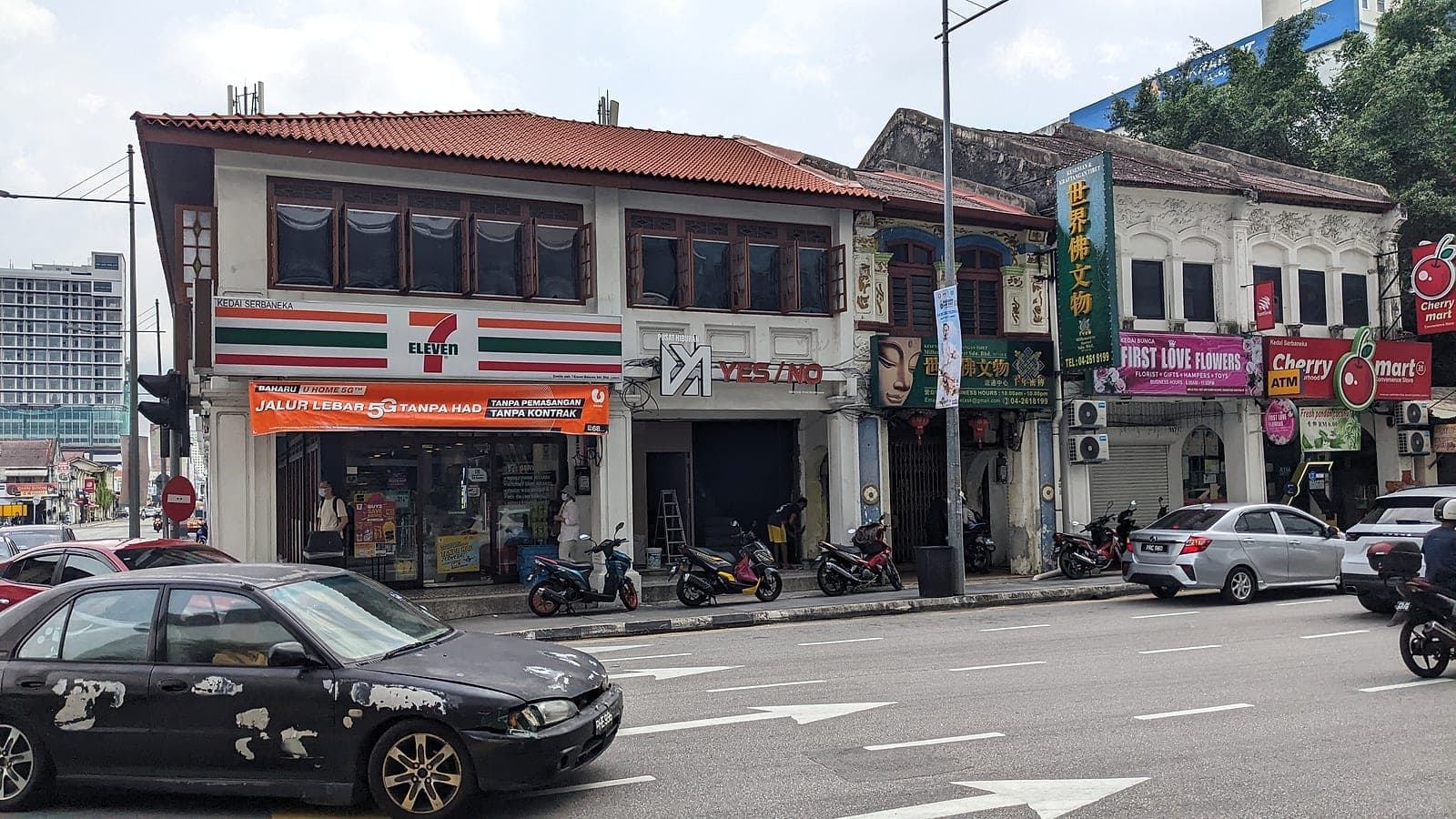
George Town is walkable. The UNESCO heritage core is roughly 3–4 km east-to-west — from the sea-front jetties on Pengkalan Weld across to the inner-city blocks behind Komtar — and you can see most of it on foot without ever opening Grab. That is the headline. The detail is that the city rewards more than one walk. There is a heritage loop, a street-art loop, a food loop, a clan-houses loop, and a colonial-waterfront loop — each with its own logic, light, and pace.
This guide is the orientation. It does not replace the tighter self-guided heritage route — that is the single 3-hour timed walk through the UNESCO core. This guide is the broader map: how to navigate George Town on foot for a two- or three-day stay, breaking the walkable city into five named loops, plus the practical heat, shade, and footwear advice that decides whether you actually enjoy any of them.
Why walking is the way
Three reasons.
The streets are heritage-era and narrow. Lebuh ("street" in Malay) Armenian, Lebuh Cannon, Lebuh Carnarvon — most of the named streets in the heritage core were laid out for foot and bullock cart traffic in the early 1800s. They are not built for cars. Parking is genuinely impossible inside the heritage zone; the few open-air lots near the Esplanade or along Pengkalan Weld fill by mid-morning.
Grab fares barely beat walking. A short hop from Lebuh Chulia to Fort Cornwallis is a 12-minute walk or an RM 6–9 Grab that often takes longer because of the one-way street pattern. For anything inside the heritage core, walking wins on time and on cost.
The texture is the point. Tour buses drop you at three hardstops; walking gets you the rest of the city — the back-alley laundry lines, the trishaws parked outside Hokkien clan halls, the smell of roasted pork floss leaking from a kopitiam mid-morning. None of that registers from a vehicle window.
The walk-friendly heritage zone is roughly bounded by Lebuh Pantai (east, near the sea), Lebuh Carnarvon / Jalan Penang (west), Lebuh Light (north, near Fort Cornwallis and the Esplanade), and Lebuh Chulia (south). Inside that rectangle, almost everything you came to see is reachable on foot. The five loops below cover it.
Loop 1 — Heritage Core (1.5 hrs, ~2 km)
The classic. If you only have one walk in George Town, this is it.
Route: Pinang Peranakan Mansion (Church Street / Lebuh Gereja) → Cheong Fatt Tze Blue Mansion (Leith Street) → Khoo Kongsi (Cannon Square, off Lebuh Cannon) → Yap Kongsi (Lebuh Armenian) → Lebuh Armenian street art cluster → Fort Cornwallis (Esplanade end).
Start at the Pinang Peranakan Mansion (RM 25 entry, guided tours run continuously). It is the most complete surviving Peranakan interior in Malaysia — Victorian floor tiles, opium beds, blue-green Peranakan porcelain. About an hour inside.
Walk west to the Cheong Fatt Tze Blue Mansion on Leith Street. The indigo-blue facade is the most reproduced heritage image in Penang. Tours of the interior run twice daily, at 11am and 3:30pm (RM 25 per adult); the courtyard and blue-tiled inner well are the highlight. Facade-only photos from the street are free.
Cut south through the heritage lanes to Khoo Kongsi at Cannon Square — the most ornate Hokkien clan temple in the country, with carved granite columns, a gilded interior altar, and a clan-history museum on the upper floor. Worth the RM 15 entry.
From Khoo Kongsi it is a five-minute walk to Lebuh Armenian for the Zacharevic mural cluster ("Children on a Bicycle", "Boy on Bike"). Continue east along Armenian Street to the Goddess of Mercy Temple, then north along the heritage street grid to Fort Cornwallis (RM 20) at the sea end of Lebuh Light. The fort is the oldest surviving British fort in Malaysia; the cannon row and seaward bastion give you a clean closing view of the Malacca Strait.
This is the timed-and-routed version of the walk. If you want it tighter — exact street-by-street directions, stop-by-stop notes — see the self-guided heritage walk.
Loop 2 — Street Art Trail (1.5 hrs, ~2 km)
The murals everyone comes for, plus the iron-rod sculptures most people miss.
Route: Lebuh Armenian (Zacharevic murals + iron sculptures) → Lebuh Ah Quee (more murals + ironwork sculptures) → Lebuh Cannon ("Brother & Sister on a Swing") → Lebuh Pantai (newer pieces, 2018 onwards).
Lithuanian artist Ernest Zacharevic's 2012 commission for the George Town Festival put the city on the global street-art map. The originals — "Children on a Bicycle" with the real bicycle mounted to the wall, "Boy on Bike", "Little Children on a Swing" — are clustered on Lebuh Armenian and the immediate side lanes.
The lesser-known second layer is the Mirrors George Town iron-rod sculpture series — 52 black silhouette caricatures of historical street life, distributed across the heritage zone at eye level: a trishaw rider, a char kway teow hawker, children playing. Easy to miss if you are scanning walls for large murals. Lebuh Ah Quee has the densest cluster.
Newer pieces from 2015 onwards have spread along Lebuh Pantai and the streets behind the colonial waterfront. These are often larger-scale and less photographed than the Armenian Street originals.
Best done early morning (7:30–8:30am) before the tour groups arrive, or after 6pm when the queues at "Children on a Bicycle" clear. For the full mural-by-mural breakdown with locations and artist credits, see the George Town street art guide.
Loop 3 — Food Trail (3 hrs, ~2.5 km, slow with stops)
This is a walk paced around eating, not around photography. Allow three hours, and only do it hungry.
Route: Kimberley Street hawker line (lunch) → Lebuh Chulia coffee shops → Lebuh Carnarvon kopitiams → Hong Kee Wan Tan Mee → Tek Sen Restaurant → Penang Road Famous Teochew Chendol.
Kimberley Street (Lebuh Kimberley) is the lunchtime anchor — a stretch of pavement-table hawkers serving duck koay chiap, sister curry mee, and char koay kak from late morning. Order at the stall, sit at any plastic table, the floating staff will collect your money.
Walk south to Lebuh Chulia for kopitiam coffee. Sin Kheng Aun is the canonical stop — 1930s coffee shop, marble tables, robusta with butter-roasted beans, kaya toast on charcoal-grilled white bread. RM 6–9 for the set.
Lebuh Carnarvon runs parallel and has another generation of kopitiams plus the legendary Penang Road Famous Prawn Mee at No. 51 (morning and lunch only — sells out by 11am most days).
For lunch proper, Hong Kee Wan Tan Mee (Lebuh Cintra, just off Carnarvon) does the Penang dry version — egg noodles tossed with dark soy sauce, char siu pork, and pickled green chillies on the side. Tek Sen Restaurant on Lebuh Carnarvon is the heritage-zone tze char standout; the double-roasted pork belly is the signature.
End at Penang Road Famous Teochew Chendol on Jalan Penang — a 90-year-old cendol stall with a long but fast-moving queue. Pandan-flavoured rice-flour worms in shaved ice, palm sugar syrup, coconut milk, kidney beans. RM 4 at the counter, eaten standing.
For the timed sequence including evening hawker stops at Lorong Selamat and Gurney Drive, see the George Town food trail.
Loop 4 — Clan Houses & Temples (2 hrs, ~2 km)
The cultural-density loop. Five clan houses and three multi-faith temples in two hours, all on foot.
Route: Khoo Kongsi → Cheah Kongsi → Yap Kongsi → Tan Kongsi → Goddess of Mercy Temple (Kuan Yin Teng) → Sri Mahamariamman Temple → Acheen Street Mosque (Masjid Melayu Lebuh Aceh).
The kongsi (clan associations) were the social-welfare and self-governance backbone of immigrant Hokkien Penang in the 19th century. Each surname group built a temple-cum-meeting hall, often with a school and a mutual-aid fund attached. Khoo Kongsi is the most visited and most ornate. Cheah Kongsi (Lebuh Armenian end) and Yap Kongsi (off Armenian Street) are smaller, less restored, and often have no entry queue at all. Tan Kongsi is on Seh Tan Court, a quiet courtyard worth ten minutes.
The temple corridor on Jalan Masjid Kapitan Keling is the irreducible cultural section: Kuan Yin Teng (Hokkien Buddhist-Taoist, 1728), Sri Mahamariamman (Hindu Chettiar Dravidian, 1833), and Masjid Kapitan Keling (Indian Muslim Mughal, 1801) all within a 500-metre stretch. The Acheen Street Mosque to the south — Sumatran-influenced timber architecture — closes the loop on the Malay side.
Cultural notes: Shoes off at every temple and mosque. Dress modestly — shoulders and knees covered. Sarongs and headscarves are loaned at mosque entrances if needed. Photography of worshippers should be done with permission; quiet observation is always welcome.
Loop 5 — Waterfront & Colonial (1.5 hrs, ~2.5 km)
The British-administration corridor — open lawns, white facades, sea views.
Route: Esplanade (Padang Kota Lama) → Town Hall and City Hall → Fort Cornwallis → Penang Clock Tower (Queen Victoria Memorial) → Weld Quay (Pengkalan Weld) → clan jetties (Chew, Tan, Lee, Lim, Yeoh).
The Esplanade is the open green space facing the Malacca Strait. The Town Hall (1880) and City Hall (1903) sit at the western edge — both white, both operational, both photographable from the lawn. Fort Cornwallis anchors the eastern end. The Penang Clock Tower — a Moorish-influenced 60-foot Queen Victoria Diamond Jubilee memorial built in 1897 — sits at the corner of Light Street and Beach Street.
From the clock tower, walk south along Pengkalan Weld (Weld Quay), the working waterfront and ferry terminal. The clan jetties — six stilt-house villages built over the sea by Hokkien clan groups from the 1800s onwards — start about 600 metres south of the ferry terminal. Chew Jetty is the largest and most commercial; Tan, Lim, and the Mixed Jetty are quieter and more residential.
This loop is best done late afternoon. The colonial buildings catch warm reflected light from the west, and the jetties at golden hour are the photograph everyone comes for.
Practical walking tips
Heat: Real but manageable. Penang is 1.5 degrees north of the equator; the midday sun is straight overhead. Plan around it: walk 7am–10am (cool air, soft light, temples active), siesta 11am–3pm (kopitiam, museum, hotel pool), resume 4pm–7pm (golden hour, hawker stalls setting up).
Hydrate: Bottled water is RM 1–3 from any 7-Eleven, mamak, or hawker stall. Carry one bottle, refill or replace every 90 minutes.
Footwear: Walking sandals (Teva, Chaco) or trainers. Not dress shoes. Heritage streets are five-foot-way colonial pavements — cobblestones, broken flagstones, occasional sudden drops. Flat closed-toe is best.
Five-foot ways: The covered colonnaded walkways running along the front of every heritage shophouse. They are continuous shade for most of the heritage zone — use them. Walking under the five-foot way drops the perceived heat by 5–7°C compared to walking on the open road.
CAT shuttle as backup: The free Central Area Transit orange shuttle bus runs every 20–30 minutes around a fixed loop through the heritage core — Komtar to Weld Quay to Fort Cornwallis and back. Useful if you tire mid-walk or need to get from Kimberley Street back to Komtar quickly. No fare, just board.
Rain: May–October has afternoon thunderstorms — usually 3–5pm, lasting 30–60 minutes. Carry a small umbrella or duck into a kopitiam and order another iced coffee. The shophouse five-foot ways will keep you mostly dry between buildings.
Beyond walking distance
A few obvious destinations are not in the walkable zone — they require a Grab or the rapidPenang bus.
- Penang Hill — funicular up from Air Itam, 25–30 minutes by Grab from George Town.
- Kek Lok Si Temple — same Air Itam area, plan together with Penang Hill as a half-day.
- Batu Ferringhi beach — 25 minutes by Grab; not in the heritage zone at all.
- Balik Pulau (rural southwest) — 45 minutes by Grab; durian orchards, fishing villages, and a different visual register.
All require transport. The walking-guide framework ends at the edges of the heritage zone — for getting further, see getting around Penang.
Practical close
If you have two days: Loop 1 (heritage core) on Day 1 morning, Loop 2 (street art) Day 2 morning, Loop 3 (food) Day 2 evening. That is the irreducible minimum and covers what most first-timers come to George Town to see.
If you have three days: Add Loop 4 (clan houses) on Day 1 afternoon and Loop 5 (waterfront) on Day 3 late afternoon. The clan-houses loop is the cultural depth that most one-day visitors miss; the waterfront loop is best at golden hour and pairs well with a sunset drink at one of the seafront hotels.
For a personalised version that accounts for your interests, dietary needs, and pace — including which loops to compress or expand — try the AI trip planner. It will sequence the loops against your actual dates and rest preferences rather than the generic two-or-three-day template above.
Keep reading
Guides that pair well with this one.
Penang for Japanese Tourists: The Complete Guide (2026)
Direct flights from Osaka and Tokyo, Japanese-friendly food, and a city built on multicultural craft make Penang one of Southeast Asia's best destinations for Japanese travellers.
12 min readpracticalPenang Travel Tips: 25 Things to Know Before You Go (2026)
First-time Penang trip? 25 specific, no-fluff travel tips on money, transport, food, weather, etiquette, SIMs, and the things tourists consistently underestimate.
11 min readneighborhoodsArmenian Street George Town — Complete Guide
Lebuh Armenian is the most-photographed street in Penang. Here's what's actually on it, what's nearby, and how to see it without just following the mural trail.
7 min readculturePenang Architecture Guide: Shophouses, Colonial Mansions & Heritage Streets (2026)
George Town has more surviving pre-war architecture than almost any city in Southeast Asia. Here's how to read the buildings — what each style means, and which streets are worth walking.
8 min read