On this page
George Town Food Trail: The Complete Walking Guide (2026)
Walk George Town's best hawker stalls, kopitiams, and street food stops in order. Morning laksa, Hokkien mee, char kway teow, cendol — with addresses, hours, and a mapped route through the heritage zone.
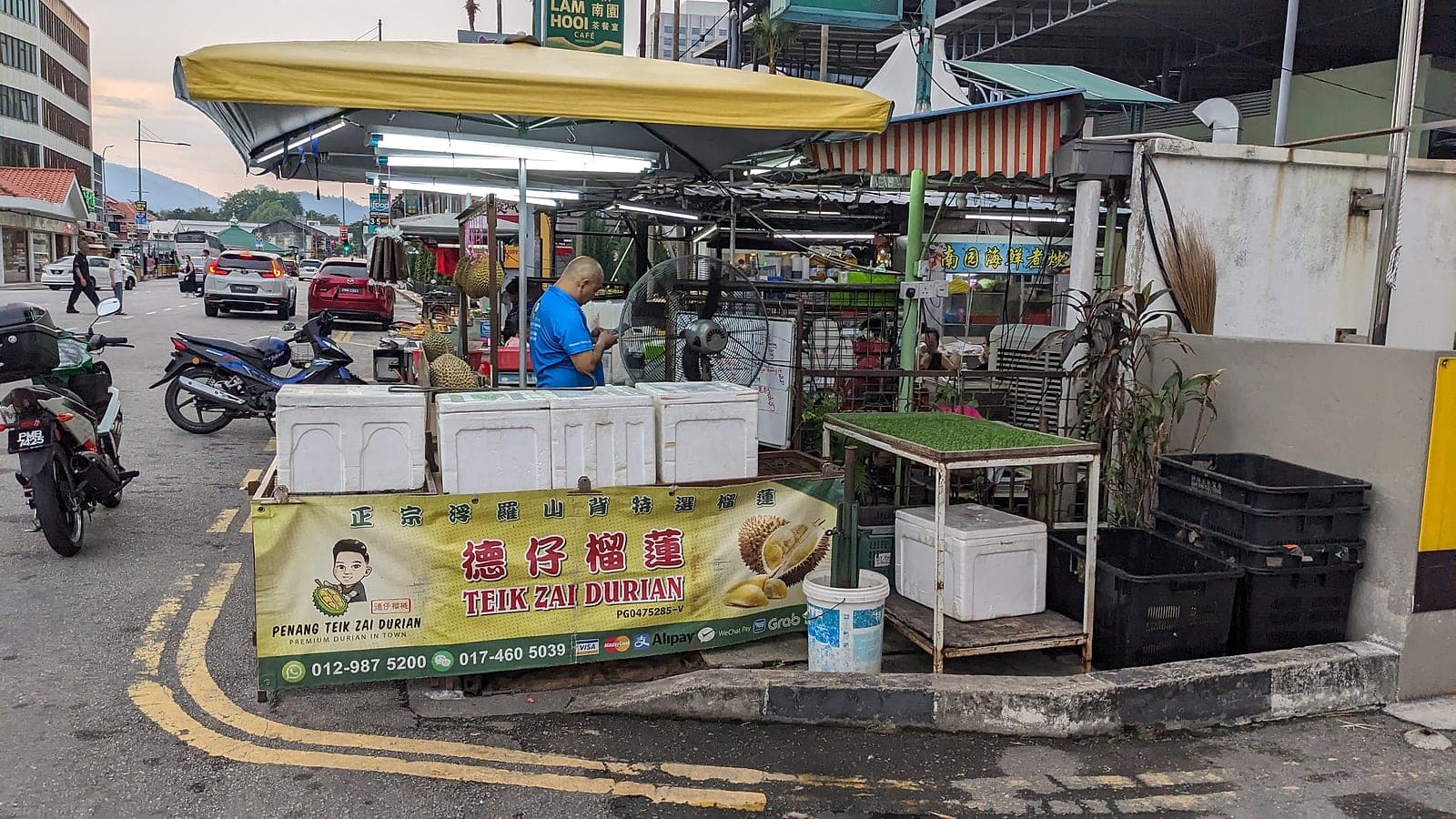
The best way to eat in George Town is not to have a plan. The second-best way is this guide.
Penang's food is hawker food — it lives in open-air centres, in kopitiam coffee shops on the ground floors of pre-war shophouses, and at single-table mobile carts that materialise at dusk. Each stall does one dish. The quality ceiling is high and the price ceiling is low. A full day of eating — breakfast, mid-morning snack, lunch, afternoon cendol, and dinner — rarely costs more than RM 60 per person.
This trail is structured as a walk through George Town's heritage core. You can do it in a single day or use it as a reference to build your own sequence over two or three days.
This trail works best starting at 7:30am. The hawker world is primarily a morning and evening operation; the midday gap is when you rest, explore the heritage zone, or drink coffee. Start early, rest at noon, resume at 5pm.
First-time and returning visitors who want to eat seriously — not just tick a list of Penang dishes but understand the logic of when and where each one is at its best
Morning: 7:30am–11am
Stop 1 — Roti Canai at a Mamak Restaurant (7:30am)
Before the hawker world fully opens, the mamak restaurants are already running. These are Muslim-Indian owned eateries serving roti canai (a flaky pan-fried flatbread) with dhal curry, fish curry, or dal lentils on the side, and teh tarik (pulled tea, condensed milk, frothed between two cups until the surface foams).
This is the correct breakfast. RM 3–5 total.
Where to go: Any mamak on Penang Road (Jalan Penang) between the Komtar tower and the E&O Hotel stretch. Taj Restaurant near the junction of Penang Road and Jalan Masjid Kapitan Keling has been a neighbourhood fixture for decades. You'll see the roti canai being folded and cooked through the open kitchen.
Eat at the plastic table outside. The footpath is your dining room.
Stop 2 — Hokkien Mee / Prawn Mee (8:30am)
Penang Hokkien mee — called prawn mee in most of Malaysia — is a dish that takes its seriousness from the broth. Pork bones and prawn shells are simmered together for hours, producing a dark, amber-tinged soup of unusual depth. It is served over thin yellow egg noodles and rice vermicelli, topped with medium prawns, half a hard-boiled egg, kangkung (water spinach), and a spoonful of sambal chilli on the side.
This is a morning dish. Most serious prawn mee stalls are done by 11am.
Where to go: Penang Road Famous Prawn Mee at 51 Lebuh Carnarvon has been operating for decades and remains the reference point. Get there before 9am — queue builds fast and sell-out is real. Dry version (no soup, sambal-dressed noodles) is available if you prefer.
Price: RM 7–12 depending on prawn size.
Stop 3 — Kopitiam Coffee and Toast (9:30am)
Between the prawn mee and the next hawker stop, you need coffee. Not café coffee — kopitiam coffee.
A kopitiam is a traditional Chinese coffee shop that has been running essentially unchanged since the early 20th century: marble-topped tables, wooden chairs, a coffee counter, and a set of regulars who have been occupying the same seats for thirty years. The coffee is robusta-based, roasted with sugar and butter (or occasionally lard), brewed through a sock filter, and served in a thick ceramic cup with condensed milk unless you specify otherwise.
Kaya toast is the standard accompaniment: white bread toasted over charcoal, spread with kaya (coconut-egg jam) and a thick slab of cold salted butter. Eaten with soft-boiled eggs seasoned with dark soy sauce.
Where to go: Toh Soon Café (Armenian Street, on the right side heading toward the Zacharevic mural) is a narrow alley kopitiam wedged between shophouses. The queue wraps onto the street on weekend mornings. Worth the wait. Alternatively, Sin Kheng Aun on Lebuh Chulia is less photographed and equally good.
Price: RM 6–9 for coffee and toast set.
Stop 4 — Char Kway Teow (10:30am)
By late morning the hawker centres are fully open. This is when you eat char kway teow.
Flat rice noodles — kway teow — are cooked over a charcoal or wood fire in a blackened cast-iron wok with a short, intense burst of heat that produces wok hei: the smoky, slightly caramelised flavour that can only be achieved at extremely high temperatures. The standard version includes cockles, bean sprouts, egg, Chinese sausage, and lard pieces fried into the noodles. Dark soy sauce and a spoonful of chilli paste are added at the end.
The quality depends entirely on the cook and the heat of their fire. A poor version is slippery, under-flavoured, and forgettable. A good version is one of the best things you'll eat in Southeast Asia.
Where to go: Sri Weld Food Court near the waterfront has multiple reliable char kway teow stalls. For the benchmark version, the stall at Lorong Selamat (evening only — see below) is the most consistent. If you can only have char kway teow once, do it in the evening at Lorong Selamat.
Price: RM 7–12.
Midday Rest: 11am–4pm
This window is genuinely hot in George Town. The hawker world operates around this reality: the morning session winds down, and serious eating resumes at dusk.
What to do at midday: explore the heritage zone on foot (Armenian Street street art, Khoo Kongsi clan temple, Cheong Fatt Tze Blue Mansion exterior), drink coffee at China House or The Daily Dose, or take a Grab to Penang Hill for the afternoon views.
If you must eat at midday: nasi kandar restaurants are open all day. Hameediyah on Campbell Street (since 1907) is air-conditioned, reliable, and correctly priced. Order the murtabak (stuffed flatbread with minced beef and egg) or get the rice with lamb kurma and a spoonful of each curry on the counter.
Afternoon: 3pm–5pm
Stop 5 — Cendol (3:30pm)
Cendol is the correct afternoon dessert. Pandan-flavoured green rice-flour jelly worms (the cendol pieces) sit in a bowl of shaved ice with red beans and a dark, treacle-thick palm sugar syrup poured over coconut milk. It is colder, sweeter, and more refreshing than it sounds.
Where to go: Penang Road Famous Teochew Chendul on Penang Road — look for the green signage, usually with a long queue. The stall has operated here for over 80 years. The Jalan Burmah branch is slightly less crowded if the Penang Road queue is long.
Price: RM 3.50–5.
Stop 6 — Assam Laksa (4:30pm)
Assam laksa is Penang's most distinctive noodle dish and one of the most argued-about in Malaysian food culture. The broth is sour — built on mackerel (ikan kembung) simmered with tamarind, lemongrass, torch ginger flower, and shrimp paste. It is thick, pungent, and deeply savoury. Thick rice noodles sit in the broth; shredded fish, cucumber, onion, and pineapple float on top. A spoonful of hae ko (dark prawn paste) is stirred in at the table.
This is not a mild dish. The sour-fishy-shrimp-paste combination is an acquired appreciation for some first-time eaters. Eat it anyway.
Where to go: Joo Hooi Café at 475 Jalan Penang is the most accessible benchmark — open from midday until evening, centrally located. For the reference-standard version, the laksa stall at Air Itam market (a 20-minute Grab from the centre) is worth the trip.
Price: RM 5–8.
Evening: 6pm–10pm
Stop 7 — Char Kway Teow at Lorong Selamat (7:30pm)
The evening session at Lorong Selamat is the definitive char kway teow experience. The stall cooks over very high heat; the cockles are fresh and only added at the last second; the lard pieces are rendered crisp. Order with cockles ("ah hiong" in Hokkien, or just point and ask) and specify chilli level.
Where to go: Off Jalan Macalister — the stall is signposted from the road. Evening only, from around 6pm. Queue is expected; bring patience or go before 7pm.
Stop 8 — Gurney Drive Hawker Centre (8:30pm)
The evening ends at Gurney Drive. The hawker centre on the reclaimed seafront promenade has around 25 stalls operating from late afternoon until midnight, with views over the Malacca Strait. All stalls are halal.
What to order here:
Pasembur (Indian rojak) — a Penang-specific salad of crispy fried dough fritters, boiled potato, hard-boiled egg, cucumber, bean sprouts, and turnip, dressed with a thick orange-red sweet-spicy sauce made from sweet potato and chillies. This dish is specific to Penang mamak culture and rarely found at this quality outside the island.
Satay — skewered beef or chicken, charcoal-grilled and served with peanut sauce and ketupat (compressed rice). The hawker centre satay is notably better than hotel restaurant satay.
Fried oyster omelette — fresh oysters cooked into a soft omelette with starch and egg, cut at the table. A seafront hawker speciality.
Grilled seafood — whole fish or stingray wrapped in banana leaf, grilled over charcoal, and served with sambal. Order by weight.
Price for a full spread for two: RM 35–55.
Evening timing
Gurney Drive hawker centre comes alive between 7pm and 10pm. Arrive before 7pm to secure a table at peak times; the seafront promenade gets a sea breeze in the evening that makes outdoor dining pleasant even in the heat. Most stalls accept card — cash is faster.
Practical Notes
Cash: Hawker stalls still prefer cash. Carry RM 50–100 in small bills for the day. Kopitiams almost never take card; hawker centres increasingly do.
Pace: The best hawker meals are eaten without rushing. Queue, sit, eat, leave when you're done. Don't try to eat all eight stops in one day — spread them across two.
Heat management: Eat hawker food before 11am and after 5pm. Midday is not the time. The morning session has better quality and lower prices at most stalls.
What to drink: Teh tarik (hot or iced pulled tea), teh O ais (iced black tea with sugar), or coconut water. Kopi O (black coffee with sugar) if you want the kopitiam experience straight. Bottles of 100Plus isotonic drink are everywhere and useful for the heat.
Halal status: Stops 1, 2 (prawn mee — no pork broth versions available at halal stalls), 3 (check stall), 5, and 8 are fully halal. Char kway teow (Stop 4, 7) and assam laksa at traditional stalls (Stop 6) are generally not halal. Hameediyah and Gurney Drive are entirely halal.
Getting around: The heritage core is walkable for all morning stops. Assam laksa at Air Itam requires a Grab (RM 12–18 each way). Lorong Selamat and Gurney Drive are 5–10 minutes by Grab from the heritage zone.
Further Reading
- Penang's Best Dishes — full dish-by-dish breakdown with variants
- Penang Hawker Guide — every major hawker centre reviewed
- George Town Neighbourhood — orientation for first-time visitors
- Halal Dining in Penang — fully halal-certified dining guide
Keep reading
Guides that pair well with this one.
Dishes Invented in Penang — and Where to Try the Originals
Char kway teow, Penang laksa, cendol, lor mee — several of Malaysia's most iconic dishes were invented or perfected in Penang. Here's the origin story and where to eat the real thing.
6 min readfoodThe History of Char Kway Teow — Penang's Most Famous Dish
Char kway teow was working-class food invented by fishermen and farmers. Here's how a cheap noodle dish from pushcart vendors became one of the most discussed street foods in Asia.
6 min readfoodPenang for Food Lovers: The Complete Eating Guide
The definitive guide to eating in Penang — from dawn hawker breakfasts to late-night char kway teow. Where to eat, what to order, and the unwritten rules of the hawker centre.
8 min readplanning7 Days in Penang: The Complete Itinerary
A full week in Penang done properly — George Town's heritage zone, hawker breakfasts, Balik Pulau countryside, Batu Ferringhi, hill walks, day trips, and the meals that make the island worth returning to.
12 min read