Penang Heritage Hotel Architecture Guide 2026
Understand what you are actually looking at — Straits Eclectic, Southern Chinese Shophouse, and Art Deco explained with hotel examples
What architectural styles will I find in Penang heritage hotels?
George Town's heritage hotels span three main styles: Straits Eclectic (1890s–1930s) — exuberant Chinese-European mansions with sky wells and vivid colours; Southern Chinese Shophouse (1840s–1920s) — narrow, deep buildings with five-foot covered walkways and air wells; and Art Deco (1920s–1940s) — streamlined geometry, terrazzo floors, and modernist restraint. Most heritage hotels occupy one of these styles; some combine elements of two.
Why Penang Has This Architectural Diversity
Penang became one of Southeast Asia's most architecturally rich cities because of a single geographical accident: its position at the northern entrance to the Strait of Malacca, the busiest shipping lane in the pre-modern world. When Francis Light established the British colony in 1786, traders flooded in from every direction — Hokkien and Teochew merchants from southern China, Tamil Muslim traders from the Coromandel Coast, Chettiars from Tamil Nadu, Armenians from Persia, Acehnese traders from Sumatra, and eventually Peranakan (Straits-born Chinese) families who had been in the region for generations.
Each community built in its own tradition, within a colonial framework that mandated certain urban rules — the five-foot-way walkway, the setback from the street, the frontage tax that shaped the shophouse's narrow width and great depth. The result, accumulated over 150 years, is a layered urban landscape unlike anywhere else: Chinese shophouses standing next to Indian mosques standing next to colonial Georgian civic buildings standing next to Peranakan mansions of wild eclecticism.
UNESCO inscribed George Town as a World Heritage Site in 2008, recognising this "outstanding universal value." Strict conservation laws now protect the building stock, and hundreds of these structures have been sensitively converted into boutique hotels — giving visitors not just a place to sleep, but an architectural experience impossible to replicate in a modern building.
Straits Eclectic
1890s–1930s
A uniquely Malayan fusion of Chinese craftsmanship with European Baroque, Renaissance, and Art Nouveau motifs — the most photographed style in George Town.
Straits Eclectic is the architectural language that makes George Town visually unlike anywhere else on earth. It emerged in the late 19th century as Penang's prosperous Straits Chinese (Peranakan) merchant class commissioned grand townhouses and clan mansions that would reflect their extraordinary wealth and hybrid cultural identity. The result was a collision of traditions: Chinese master craftsmen from Fujian and Guangdong applying their centuries-old skills in carved timber, hand-painted ceramic tiles, and elaborate plasterwork — but working within European structural frameworks of symmetrical facades, neoclassical columns, Baroque pediments, and Renaissance arches.
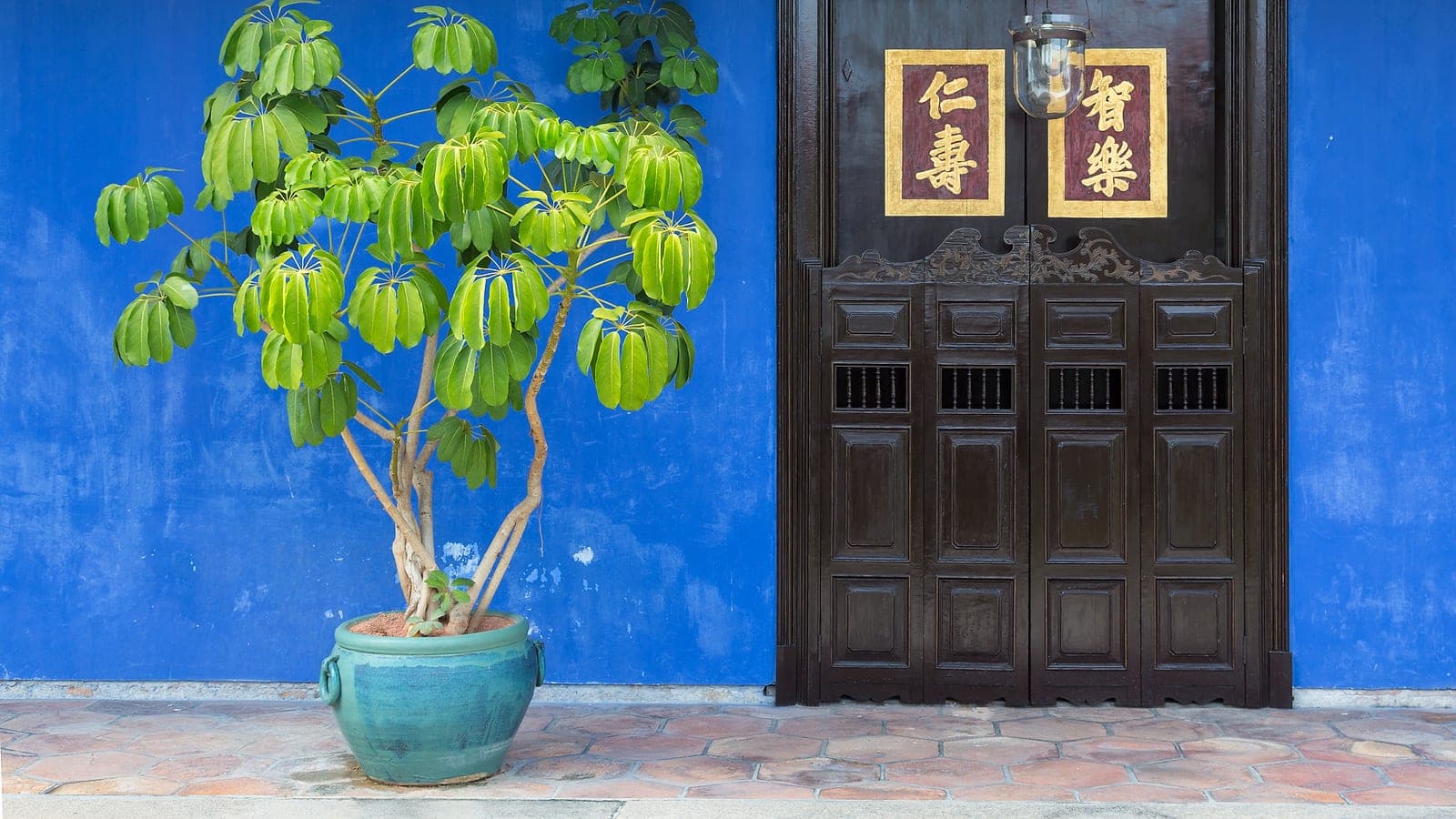
The style is characterised by theatrical excess. Facades are layered with ornamental detail: gilded Chinese calligraphy panels sit beside Corinthian pilasters; Peranakan floral motifs crowd the same wall as European egg-and-dart mouldings; traditional Chinese "bat and coin" luck symbols are carved into Western-style keystones above the doors. The colour palette runs to vivid indigo, mustard yellow, terracotta, and sage green — a defiant contrast to the whitewashed British colonial buildings nearby.
Inside, Straits Eclectic buildings follow the Chinese courtyard house (or "great house" — Hokkien: "tua chu") plan: a sequence of internal courts separated by screens and halls, designed to draw in light and air while maintaining domestic privacy. These inner courtyards, called "sky wells" (天井, tiānjǐng), are engineering as much as aesthetics — the chimney effect pulls hot air upward while channelling rainwater into underground cisterns. Guests staying at a Straits Eclectic heritage hotel often sleep in rooms that open directly onto these atmospheric courtyards, an experience impossible to replicate in a modern hotel.
The finest examples in George Town were built between 1880 and 1910, the commercial zenith of the Straits Settlements. Cheong Fatt Tze — the "Rockefeller of the East" — commissioned the most famous example, his indigo mansion on Lebuh Leith, completed around 1904. The building synthesises Scottish cast-iron spiral staircases, northern Chinese carved screens, English encaustic floor tiles imported from Stoke-on-Trent, French louvred shutters, and Cantonese wood-carved panels into a single coherent whole. That synthesis — the confidence to borrow from everywhere and create something distinctly local — is the essence of Straits Eclectic.
UNESCO recognised the style's global significance when George Town was inscribed as a World Heritage Site in 2008. Today, the George Town World Heritage Incorporated (GTWHI) body enforces strict conservation guidelines for any renovation within the buffer zone, ensuring that future generations can still read the full complexity of this unique urban landscape.
Key Architectural Features
- 1Symmetrical facades with layered ornamental plasterwork mixing Chinese and European motifs
- 2Internal sky wells (tiānjǐng) — open courtyards that ventilate and illuminate the building
- 3Five-foot ways (covered pedestrian verandahs) on the ground floor, standardised by Stamford Raffles
- 4Imported encaustic floor tiles from England and Belgium in geometric and floral patterns
- 5Louvred timber shutters (French-influenced) for light and airflow control
- 6Carved and gilded timber screens, doors, and altar panels by Fujian craftsmen
- 7Vivid paint colours — indigo, mustard, terracotta — applied to ornamental plasterwork
- 8Baroque-influenced roof ridges with ceramic figurines of dragons, phoenixes, and deities
What to Look For: Distinctive Elements
Five-foot way
the covered public walkway running beneath the first-floor overhang, mandated by colonial law to keep pedestrians dry during monsoon rains
Sky well (tiānjǐng)
the internal light shaft and courtyard that acts as a passive cooling system and symbolic connection to the heavens
Louvred shutters
adjustable timber blades that filter light and breeze without glass — a French Colonial adaptation for tropical climates
Encaustic tiles
machine-pressed decorative floor tiles imported from Britain and Belgium, featuring geometric and floral patterns in earth tones
Dougong brackets
traditional Chinese interlocking wooden brackets supporting the roof eaves without nails
Peranakan floral plasterwork
high-relief moulded plaster panels depicting peonies, chrysanthemums, and bat-and-coin symbols in Chinese cosmological tradition
Carved granite door jambs
stone plinths with incised calligraphy panels flanking main entrances, often with the family clan name or auspicious phrases
Scottish cast-iron spiral staircases
imported structural ironwork found in the grandest mansions, contrasting with the timber interiors
Hotels Representing This Style
RM550–RM1,200/night
The definitive Straits Eclectic experience. 18 rooms within a UNESCO Award of Excellence winner. Guided architectural tours included for guests. The indigo facade, sky wells, and Scottish cast-iron staircases are textbook examples of the style.
RM600–RM1,500/night
Seven Anglo-Indian terraced houses from the early 1800s restored by heritage champion Chris Ong. The Peranakan antique furniture and original encaustic tile floors make this one of the most authentic stays in George Town.
How Penang Protects These Buildings
George Town was jointly inscribed as a UNESCO World Heritage Site in 2008 alongside Malacca. Within the core and buffer zones, all renovation and new construction must comply with the George Town Special Area Plan (GTSAP), enforced by the Penang State Government and overseen by George Town World Heritage Incorporated (GTWHI). Owners of listed buildings receive tax incentives for heritage-compliant restoration. The Penang Heritage Trust and Think City have provided millions in grant funding for private owners restoring Straits Eclectic properties. The UNESCO inscription explicitly cited the "outstanding universal value" of the multicultural architectural townscape.
Where to See the Best Examples
- Lebuh Leith (Leith Street) — home of the Blue Mansion and The Edison; the grandest Straits Eclectic mansions in George Town
- Armenian Street (Lebuh Armenian) — dense concentration of Peranakan clan houses and the famous street art murals
- Lorong Stewart (Stewart Lane) — location of Seven Terraces; quieter and less touristed
- Jalan Masjid Kapitan Keling — mixed Straits Eclectic and colonial buildings near the waterfront
- Penang Peranakan Mansion on Church Street — the most complete Peranakan interior museum in the region
Southern Chinese Shophouse
1840s–1920s
The commercial backbone of George Town — long, narrow buildings with ground-floor shops, domestic living quarters above, and the iconic five-foot covered walkway that defines Penang's streetscape.
The Southern Chinese shophouse is the fundamental building unit of George Town and the architectural type that most shaped the city's daily life for over 150 years. Originally built by Hokkien (Fujian), Teochew (Chaozhou), and Cantonese immigrants who arrived in Penang from the 1780s onwards, the shophouse pattern translated directly from the mercantile towns of southern China into the tropical conditions of a British colonial port.
The defining characteristic is the building's unusual proportions: extremely narrow frontage (typically five to seven metres wide) but extreme depth — often extending 30 to 50 metres back from the street. This "five-foot way plus long room" plan was driven by colonial land tax assessments that charged by frontage width, incentivising owners to build deep rather than wide. The result was a building type where the ground floor opened directly to the street for trade, the upper floors housed the owner's family, and the rear of the building contained the kitchen, wells, and servants' quarters. In between ran a narrow internal light well — the air well — that functioned as both ventilation shaft and light source for the interior rooms.
The five-foot way (known in Malay as "kaki lima" — five feet) is the most recognisable element: a covered public walkway created by the first-floor overhang of the building, running continuously along the front of each shophouse. In colonial Penang, this system was mandated by Stamford Raffles as a public amenity to shelter pedestrians from rain and sun. Today, walking the five-foot ways of Penang's heritage streets remains one of the most atmospheric urban experiences in Southeast Asia — the interplay of light through the louvred shutters overhead, the smell of incense and coffee from the businesses within, the uneven handmade floor tiles underfoot.
The shophouse's internal organisation also preserved Chinese domestic customs. The front hall, or "ting" (廳), served as the reception and business space. Behind it, the "tian jing" (天井 — sky well or air well) let light and rain into the middle section. At the rear, the family altar, kitchen, and sleeping quarters completed the domestic sequence. In the most prosperous shophouses, carved timber panels separated these spaces, and the altar would be an elaborate gilded structure holding ancestral tablets and deity figures.
Heritage hotels in shophouses give guests direct access to this spatial logic. Rooms that occupy the upper floors of a restored shophouse often retain original features: painted timber ceiling joists, lime-washed walls, handmade clay roof tiles, and original timber staircases polished by a century of use. The narrow footprint and deep plan mean rooms feel genuinely old-world — unlike boutique hotels that simply veneer a modern concrete structure with heritage finishes.
George Town has the largest intact collection of pre-war shophouses in Southeast Asia. The UNESCO inscription specifically identified their number, variety, and state of preservation as exceptional, noting that Penang retains shophouses from every decade of the 19th and early 20th century, making it an unbroken architectural timeline of Chinese immigrant urbanism in the tropics.
Key Architectural Features
- 1Extremely narrow frontage (5–7m wide) with great depth (up to 50m), driven by colonial frontage tax
- 2Five-foot way (kaki lima): the continuous covered pedestrian walkway formed by the first-floor overhang
- 3Air well (tian jing): the narrow internal light shaft between front and rear sections, providing ventilation
- 4Ground-floor commercial space opening directly to the street, upper floors residential
- 5Timber staircases, ceiling joists, and window frames crafted from ironwood (Chengal) or teak
- 6Handmade Peranakan or Qing-era ceramic floor tiles in geometric patterns
- 7Lime-washed masonry walls with a rough, warm texture unlike modern plaster
- 8Street-facing facade with traditional folding timber doors (often painted bright red) and louvred upper shutters
What to Look For: Distinctive Elements
Five-foot way
covered public walkway running under the first-floor overhang, providing shelter from rain and sun — a Raffles-era colonial mandate still defining the streetscape
Air well
the narrow internal courtyard between front and rear sections; acts as a chimney drawing hot air upward while channelling rainwater to the ground
Timber folding doors
heavy panelled doors that fold back during business hours, completely opening the ground floor to the street — a feature unique to the shophouse typology
Apothecary cabinets
in former Chinese medicine halls (like Ren i Tang), the original rows of timber drawers with brass ring pulls, each labelled with a herb name in Chinese characters
Clan association plaques
ceramic or stone panels on the facade identifying the building's ethnic clan association (Hokkien, Hakka, Cantonese), marking the street as a specific community's territory
Handmade clay roof tiles
fired in a gentle curve (pantiles), these overlap in alternating ridges and channels, shedding rain while allowing airflow beneath the roof structure
Lime mortar joints
the visible mortar between brickwork in older shophouses is soft lime rather than hard Portland cement, allowing the building to flex and breathe in Penang's tropical humidity
Rear kitchen extension
a lower, single-storey extension at the rear with an open-air washing area and a clay stove alcove, visible from the air well
Hotels Representing This Style
RM400–RM900/night
A masterclass in sensitively restoring a 19th-century Lebuh Campbell shophouse. The original courtyard, louvred windows, and timber staircase are intact. Only 12 rooms — intimate and central.
RM300–RM600/night
Converted from 1920s stables and servants' quarters originally serving a nearby shophouse mansion. Courtyard garden and exposed brick walls give an authentic sense of depth-behind-the-street.
RM250–RM500/night
A restored Chinese medicine hall (apothecary) on historic Beach Street (Lebuh Pantai). The original timber medicine cabinets, porcelain jars, and signage are preserved as the hotel's defining aesthetic.
RM40–RM180/night
An accessible entry point to the shophouse heritage experience on atmospheric Muntri Street. Original Peranakan floor tiles, timber shutters, and a central courtyard at budget prices.
How Penang Protects These Buildings
Shophouses within George Town's UNESCO core and buffer zones are subject to the Penang State Heritage Department's Special Area Plan. The plan classifies buildings into Conservation, Transitional, and Peripheral zones, each with different intervention levels. Facade changes require approval; original features like five-foot ways, roof profiles, and window proportions must be maintained. The George Town World Heritage Incorporated (GTWHI) runs an annual Heritage Awards programme recognising the best private restorations. Think City, a Khazanah Nasional urban regeneration initiative, has provided over RM30 million in grants for George Town shophouse restoration since 2010.
Where to See the Best Examples
- Lebuh Campbell (Campbell Street) — one of the best-preserved shophouse streetscapes, home to Campbell House
- Muntri Street (Jalan Muntri) — a quieter street with excellent 1920s–30s shophouses and the Muntri Mews hotel
- Love Lane (Lorong Love) — historically a street of entertainment houses, now a backpacker hub with original shophouses
- Beach Street (Lebuh Pantai) — Penang's former financial district; grand shophouses converted to banks, now some to hotels like Ren i Tang
- Chulia Street (Lebuh Chulia) — the original Tamil Muslim trading street; dense shophouse frontages now housing cafes and guesthouses
- Armenian Street (Lebuh Armenian) — the most touristed shophouse street; photogenic but representative of the form
Art Deco
1920s–1940s
Penang's interwar architectural moment — streamlined geometry, bold horizontal lines, and moderne flair that arrived via Singapore and replaced Edwardian ornament with machine-age confidence.
Art Deco arrived in Penang in the 1920s as the aftermath of World War I transformed architectural fashion worldwide. The elaborate ornamentalism of Victorian and Edwardian Baroque gave way to a new aesthetic vocabulary: clean geometric forms, bold horizontal banding, stylised floral and sunburst motifs, and a celebration of modern materials — reinforced concrete, terrazzo flooring, steel window frames, and plate glass. In Penang's context, Art Deco became the architectural language of a newly confident merchant and professional class who wanted modernity without European nostalgia.
Penang's Art Deco period (roughly 1925–1942, interrupted by the Japanese occupation) produced a distinctive body of civic, commercial, and domestic architecture that still punctuates the George Town streetscape. Key characteristics include strongly horizontal facades, often achieved through continuous sill and lintel bands running across the building front; "streamline moderne" curved corners on corner buildings; geometric frieze patterns in cast concrete above windows and at roofline level; and the replacement of traditional carved plasterwork ornament with flat, incised geometric decoration.
Where Straits Eclectic buildings are exuberant and polychromatic, Art Deco buildings tend toward restraint and linearity. The palette is often cream, white, or pale grey with contrasting dark accents at the cornices. Interior spaces in Art Deco buildings emphasise verticality — double-height entrance halls, geometric staircase balustrades in wrought iron or terrazzo, and mosaic tile floors in geometric patterns that contrast sharply with the handmade encaustic tiles of earlier shophouses.
The period also saw a distinctive hybrid: Art Deco shophouses. These retain the five-foot-way, deep-plan typology of the traditional shophouse but replace ornamental Baroque plasterwork with clean geometric cornices and streamlined pilasters. The result is a building that is recognisably Penangite in plan and programme but visually aligned with international modernity. Muntri Street has some of the finest examples, including buildings dating from the mid-1930s that are now converted to boutique hotels.
In George Town, the most famous Art Deco building is the Eastern & Oriental Hotel's Victory Annexe (1929), which supplemented the original 1885 Victorian structure with a sleek modern wing. Other notable examples include the Capitol Theatre (now restored), the Standard Chartered Bank building on Beach Street, and several civic buildings along Light Street. The style also influenced the interwar mansions along Jalan Sultan Ahmad Shah (Millionaires' Row), where Straits Chinese merchant families built homes that combined Art Deco modernity with Chinese geomantic planning.
The Japanese occupation of 1941–1945 and the postwar economic disruption ended the Art Deco building boom. The style's relative restraint — fewer decorative elements means less to restore — makes surviving Art Deco buildings somewhat easier to conserve than their Straits Eclectic counterparts, though the terrazzo flooring and geometric tile work require specialist restoration skills that are increasingly rare.
Key Architectural Features
- 1Strongly horizontal facade composition with continuous window sill and lintel bands running across the building width
- 2Streamline moderne curved corners on corner buildings and prominent balconies with curved concrete balustrades
- 3Geometric frieze patterns in cast concrete — sunbursts, zigzags, stepped chevrons — replacing earlier floral plasterwork
- 4Terrazzo flooring in geometric patterns: crushed marble aggregate set in cement, polished to a smooth, lustrous finish
- 5Reinforced concrete construction enabling wider spans and larger windows than traditional masonry
- 6Steel-framed Crittall windows (multi-pane metal sash windows) replacing timber frames
- 7Double-height entrance halls with geometric staircase balustrades in wrought iron or painted concrete
- 8Restrained colour palette — cream, white, pale grey with dark accent cornices — contrasting with Straits Eclectic's vivid tones
What to Look For: Distinctive Elements
Terrazzo flooring
composite surface of crushed marble chips set in coloured cement, ground and polished to a smooth finish — the hallmark interior surface of Penang's interwar buildings
Crittall-style steel windows
multi-pane metal-framed windows in geometric arrangements, often fixed or with small opening vents — a visible sign of modernity replacing timber shutters
Geometric plaster friezes
flat, incised, or low-relief concrete decoration at cornice and parapet level, featuring stylised chevrons, stepped pyramids, and sunburst fans
Streamline corners
the curved corner facade treatment on buildings occupying street intersections, eliminating the traditional chamfered or angled corner of earlier architecture
Geometric mosaic tile dados
coloured ceramic mosaic tiles in angular patterns lining the lower walls of entrance halls and stairwells
Cantilevered balconies
reinforced concrete balconies projecting from upper floors without visible supports, demonstrating the structural possibilities of modern concrete construction
Horizontal glazing bands
windows arranged in continuous horizontal strips across the facade, emphasising the machine-age aesthetic of streamlined transport design
Art Deco ironwork
geometric wrought-iron balustrades, door grilles, and window guards in stylised sunburst or fan patterns
Hotels Representing This Style
RM40–RM180/night
The 1926 date in the hotel name points to its interwar construction on Muntri Street. The building shows the transition from Edwardian shophouse to Art Deco: simplified cornices, streamlined pilasters, and period floor tiles. An accessible entry to the style.
RM500–RM1,100/night
Occupying an Art Deco-influenced heritage mansion on Lebuh Leith, The Edison leans into the style's geometric confidence with a monochrome interior aesthetic, terrazzo surfaces, and high-ceilinged spaces that feel genuinely of the era. The rooftop pool and bar are a contemporary layer on a solid interwar structure.
How Penang Protects These Buildings
Art Deco buildings in George Town benefit from the same UNESCO Special Area Plan protection as Straits Eclectic and shophouse properties within the heritage zone. However, their relative youth (1920s–1940s) means many were not individually gazetted as heritage structures until recently. The Penang State Heritage Department has progressively expanded the list of gazetted buildings to include significant interwar Art Deco structures. Key challenges include the deterioration of original terrazzo flooring and the loss of Crittall-style steel windows, which owners often replace with aluminium frames. The George Town World Heritage Incorporated (GTWHI) provides technical guidance on materials-compatible restoration for these buildings.
Where to See the Best Examples
- Muntri Street (Jalan Muntri) — the best concentration of interwar Art Deco shophouses in George Town
- Beach Street (Lebuh Pantai) — former banking district with several prominent 1930s Art Deco commercial buildings
- Lebuh Leith — home of The Edison hotel in an Art Deco-influenced mansion
- Eastern & Oriental Hotel Victory Annexe (1929) — the clearest example of pure Art Deco in a major Penang institution
- Jalan Sultan Ahmad Shah (Millionaires' Row) — interwar mansion district where Art Deco met Chinese domestic planning
- Penang Road — several 1930s commercial buildings with characteristic horizontal banding and geometric friezes
The Essential Heritage Architecture Walk
This self-guided 90-minute loop through George Town covers all three architectural styles without backtracking. Best in the morning (7–10am) before the heat and tourist crowds build.
- 1
Start: Lebuh Armenian (Armenian Street)
The most concentrated shophouse streetscape in George Town. Look for the five-foot ways, air wells visible through open doors, and the variety of facade ornament from plain whitewash to elaborate Peranakan plasterwork.
- 2
Beach Street (Lebuh Pantai)
Turn south to Beach Street to see the grandest commercial shophouses — former banks and trading houses, some with Art Deco renovations layered over earlier shophouse bones. Ren i Tang heritage inn is here.
- 3
Love Lane and Muntri Street
Loop back north via Love Lane (classic backpacker shophouse strip) to Muntri Street. This block has Penang's best concentration of 1920s–30s Art Deco shophouses alongside earlier shophouse buildings.
- 4
Finish: Lebuh Leith (Leith Street)
Walk west to Leith Street to see Straits Eclectic at its grandest — the Blue Mansion's indigo facade, the Edison hotel's interwar mansion, and the surrounding Peranakan clan houses. Reward yourself with coffee at Red Garden nearby.
Two More Styles Worth Knowing
These styles are less represented in the hotel inventory but define the streetscape around the heritage zone.
Mughal Revival (Indo-Saracenic)
1800s–1920s
Penang's Muslim architectural heritage is exemplified by the Kapitan Keling Mosque on Jalan Masjid Kapitan Keling, the oldest and grandest mosque in George Town. Built in 1801 by the first Indian Muslim settlers and substantially enlarged in the late 19th and early 20th centuries, the mosque blends Mughal architectural vocabulary — onion domes, horseshoe arches, Mughal pavilion rooflines — with local materials and craftsmanship. The facade is covered in cream plasterwork with carved geometric and floral patterns. The style, sometimes called Indo-Saracenic or Mughal Revival, arrived in Penang via the building traditions of the Chulias (Tamil Muslim merchants from southern India) who formed a substantial part of the early colonial trading community. The mosque demonstrates how Indian architectural traditions were transplanted and adapted in the Straits Settlements, creating buildings that read as distinctly Malayan while remaining rooted in subcontinental form. In the hotel context, guests staying near Jalan Masjid Kapitan Keling — including those at Ren i Tang or Campbell House — can walk to the mosque in under five minutes for the most direct encounter with this tradition.
Best Examples
- ›Kapitan Keling Mosque (Masjid Melayu Lebuh Aceh, also nearby)
- ›Sri Mahamariamman Temple (Hindu, but showing comparable Indo-subcontinental influence)
- ›Penang Islamic Museum
Colonial Georgian / Palladian
1780s–1850s
The oldest layer of George Town's built heritage is the Georgian and Palladian architecture introduced by the British East India Company after Francis Light established the colony in 1786. Fort Cornwallis, the Penang State Museum (the former Penang Free School, 1816), St George's Church (1818), and the Eastern & Oriental Hotel's original 1885 wing all reflect different moments in this tradition. Georgian architecture prioritises symmetry, restrained classical proportions, and the use of locally fired brick rendered in lime plaster painted white or cream. Palladian elements — central pediment, colonnaded verandahs, sash windows — were adapted for tropical conditions by raising the building on a plinth, widening the verandahs into deep shade-giving galleries, and substituting louvred shutters for the glass-paned windows standard in England. The result is a Tropical Georgian or "Verandah Colonial" style unique to the Straits Settlements. The Eastern & Oriental Hotel represents this tradition most tangibly for visitors, its sea-facing heritage wing preserving the scale, materials, and spatial experience of a 19th-century colonial institution.
Best Examples
- ›Eastern & Oriental Hotel heritage wing (1885)
- ›Fort Cornwallis (1786, reconstructed 1804)
- ›St George's Church (1818) — oldest Anglican church in Southeast Asia
- ›Penang State Museum (former Penang Free School, 1816)
- ›Suffolk House (1804) — Francis Light's restored residence
Frequently Asked Questions About Penang Heritage Architecture
What is Straits Eclectic architecture in Penang?
Straits Eclectic is a uniquely Malayan hybrid style that emerged in the late 19th century when wealthy Peranakan (Straits Chinese) merchants commissioned mansions blending Chinese craftsmanship — sky wells, carved timber screens, luck-symbol plasterwork — with European Baroque and Renaissance elements like neoclassical columns, Baroque pediments, and imported encaustic floor tiles. The result is an architecturally exuberant, multicultural style found nowhere else on earth, with the Blue Mansion (Cheong Fatt Tze) as its most famous example.
Why does Penang have so many heritage hotels in old buildings?
Penang's stock of 19th and early 20th-century shophouses, mansions, and colonial buildings survived largely intact because the city was declared a UNESCO World Heritage Site in 2008, creating strong conservation regulations. Before that, many buildings survived simply because of economic stagnation — George Town's decline as a free port after 1969 meant there was less pressure to demolish and rebuild. Since UNESCO inscription, investors and local entrepreneurs have restored hundreds of buildings as boutique hotels, making Penang one of the best cities in Asia for staying inside genuine heritage architecture.
Are heritage boutique hotels in Penang worth the higher price?
Yes, for most travellers — especially those interested in culture, design, or authenticity. Staying in a restored shophouse or mansion means sleeping in a building with real history: original floor tiles, sky-well courtyards, timber staircases, and architectural details that took skilled craftsmen months to create. Many heritage hotels are also small (under 20 rooms), so service tends to be more personal. They typically include breakfast and are walkable to all major George Town attractions. Prices range from RM200 for a mid-range shophouse to RM1,200 for the Blue Mansion.
What is a five-foot way and why does it matter in Penang?
A five-foot way (kaki lima in Malay) is the covered public walkway running beneath the first-floor overhang of a shophouse, exactly five feet wide as standardised by Stamford Raffles in the early colonial period. It was mandated as a public amenity to shelter pedestrians from Penang's tropical rain and sun. When you walk the heritage streets of George Town — Muntri Street, Campbell Street, Armenian Street — you are moving through an almost unbroken five-foot-way corridor that has functioned the same way for 150 years. Heritage hotels on these streets typically retain the five-foot way as part of the building's street-level character.
What is the price difference between staying in a heritage hotel versus a modern hotel in Penang?
Heritage boutique hotels in George Town range from RM40–180/night at budget heritage hostels (1926 Heritage), RM250–600/night at mid-range shophouse hotels (Muntri Mews, Ren i Tang), and RM550–1,500/night at premium heritage properties (Blue Mansion, Seven Terraces). Modern chain hotels and resorts occupy a similar price range: budget chains from RM100–200, mid-range from RM200–400, and luxury beach resorts from RM700 upwards. For the same money, you generally get far more character in a heritage hotel — though modern hotels offer pools, gyms, and consistent facilities that many heritage properties lack.
Explore More
All Penang Hotels
Browse all hotels by area, type, and budget
Compare Heritage Hotels
Side-by-side comparison of George Town's top stays
Hotel Finder Quiz
Answer 5 questions and get your perfect hotel match
Heritage Attractions
Top UNESCO sites and cultural landmarks near the hotels
George Town Neighbourhoods
Understand the heritage zone before you book
Budget Travel Guide
How to experience Penang heritage on a tight budget