On this page
George Town Heritage Walk: Self-Guided Route Through the UNESCO Zone
A 3-hour self-guided walk through George Town's UNESCO World Heritage core — clan jetties, shophouses, temples, mosques, and street art with exact directions.
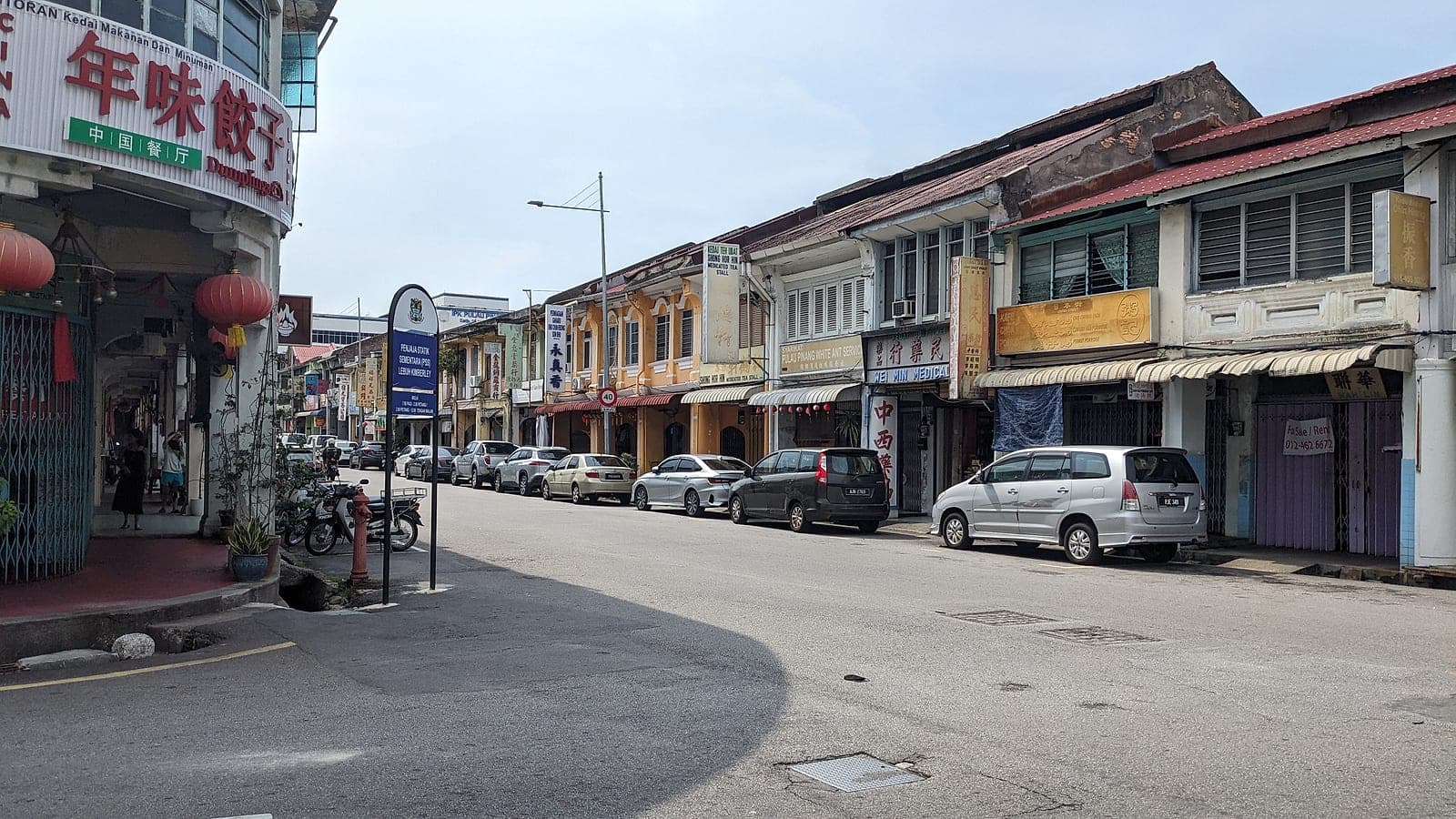
George Town was inscribed as a UNESCO World Heritage Site in 2008, jointly with Melaka, under the category of "Outstanding Universal Value" for its multicultural trading port heritage. The heritage zone covers a 109-hectare core and a 150-hectare buffer — a compact area walkable in a morning.
What sets George Town apart from comparable heritage cities in Southeast Asia is that it is a living city, not a reconstructed one. The same two-storey shophouses that Hokkien merchants built in the 1800s are still occupied: clan associations meet on the upper floors, Hindu temples burn incense in the original compounds, and families cook over gas burners in kitchens that haven't meaningfully changed in fifty years. The UNESCO listing didn't freeze the city — it formalised what was already there.
This route connects the main nodes of that living heritage: the waterfront clan jetties, the street art on Lebuh Armenian, the multi-faith corridor on Jalan Masjid Kapitan Keling, the Peranakan quarter on Church Street, and the Indian commercial district. It runs roughly south to north, starting at the sea.
Practical Information
- Distance: approximately 3.5km end-to-end
- Walking time: 2.5–3 hours at a steady pace without stopping; 4–5 hours if you enter buildings and eat along the way
- Best time: Before 10am (cool air, good light on the east-facing murals, temples active with morning prayers) or after 4pm (hawker stalls setting up, fewer tour groups, golden-hour light on shophouse facades)
- Avoid: Midday in July–September — heat and humidity compound quickly in the narrow streets, and afternoon rain is likely from June onwards
- Wear: Closed shoes (uneven five-foot way flagstones), light clothing (you will be entering temples and a mosque — bring a scarf or sarong), and carry water
- Cost: The route is free except for the optional Penang Peranakan Mansion entry (RM 25 adults)
- Map: Trace the route on our interactive Penang map, or print a copy to carry with you
Stop 1 — Clan Jetties (Pengkalan Weld)
Start at the waterfront on Pengkalan Weld (Weld Quay). The Clan Jetties are six stilted wooden villages built over the sea by Chinese clans who arrived in Penang from the 1800s onwards. Each jetty belongs to a clan surname group: Chew (Tan), Tan, Lee, Lim, Mixed Clan, and Yeoh. The jetties are connected to the mainland by long piers; families live in wooden houses above the water, with the pier running past their front doors.
Chew Jetty is the largest, most intact, and most visited. Walk the main pier from the entrance gate past the rows of family homes — potted plants on windowsills, laundry on poles over the water, fishing nets hung to dry. At the end of the pier is the Chew Clan Association temple, a compact shrine with paper lanterns and offerings of fruit. During Chinese New Year, the decorations go up in January and often stay through March.
The best part of the Clan Jetties is the side alleys off the main pier. Turn into any of the narrower boardwalks and you're immediately away from the tourist traffic — a different texture of the place, quieter, more residential. Budget 30–45 minutes if you explore both the main pier and the alleys; 20 minutes if you're short on time and just walk the central pier.
The other jetties (Tan, Lee, Lim, Yeoh) are less visited but worth a brief stop. Tan Jetty has a well-preserved clan temple. Yeoh Jetty is the smallest and most genuinely residential of the group.
Stop 2 — Lebuh Armenian (Armenian Street)
From the Clan Jetties, walk north on Jalan Tun Syed Sheh Barakbah (the main coastal road) for approximately 600 metres, then turn left onto Lebuh Armenian.
The street's most famous works are by Lithuanian-born artist Ernest Zacharevic, commissioned in 2012 for the George Town Festival's "Arts of the Streets" project. "Children on a Bicycle" — at the corner of Lebuh Armenian and the adjacent lane — uses an actual rusting bicycle mounted to the wall, with two children painted in around it. The real object integrated into the painted surface was deliberate: Zacharevic's brief was to make art that was in conversation with the street rather than simply applied to it. "Boy on Bike", a few metres away, is the solo painted figure most visitors photograph.
The street also has 52 steel-rod caricature sculptures dotted across the heritage zone at eye level — a trishaw rider, a char kway teow hawker, children playing — easy to miss if you're scanning walls for large murals.
Kuan Yin Teng (Goddess of Mercy Temple) is at the eastern end of Lebuh Armenian, at the corner of Jalan Masjid Kapitan Keling. Founded in 1728 by Hokkien and Cantonese settlers, it's the oldest Chinese temple in Penang. Joss stick smoke is constant; the temple courtyard has a full morning rhythm of worshippers leaving offerings. Remove shoes at the entrance; photography of worshippers should be done with permission.
The Syed Alatas Mansion at No. 128 is a 19th-century merchant building with Moorish-inflected architecture that reflects the Arab-Malay trading class present in early George Town. It now houses community organisations; the exterior facade is worth noting.
For a detailed account of what's on Armenian Street, see the Armenian Street guide.
Stop 3 — Kapitan Keling Mosque (Jalan Masjid Kapitan Keling)
Turn right (east) at the end of Lebuh Armenian onto Jalan Masjid Kapitan Keling, the street historically known as Pitt Street and now sometimes called Harmony Street in tourism materials for reasons that become obvious within two blocks.
The Masjid Kapitan Keling is immediately on your right. Built in 1801 by Indian Muslim Chettiars — the merchant caste from Tamil Nadu who dominated the moneylending trade in early Penang — it is the largest mosque in Penang and one of the finest examples of Mughal architecture in Malaysia. The white facade and single minaret are visible from the street; the interior courtyard has a formal order that contrasts with the dense commercial activity outside.
Visitors are welcome outside the five daily prayer times (Fajr, Dhuhr, Asr, Maghrib, Isha). Remove shoes at the entrance. Sarongs and headscarves are available for loan at the gate for visitors not suitably dressed. Inside, the prayer hall itself may be off-limits to non-Muslim visitors during prayer; the courtyard and outer areas are generally accessible.
Stop 4 — Sri Mahamariamman Temple
Fifty metres south along Jalan Masjid Kapitan Keling, on the same block as the mosque, is the Sri Mahamariamman Temple (also called Nagarathar Temple). Founded in 1833 by Nattukotai Chettiars — the same community that built Kapitan Keling — the temple's ornate gopuram (entrance tower) is carved with deities in the South Indian Dravidian style.
The temple is active throughout the day: bells ring, oil lamps are lit, and jasmine garlands are sold from a stall near the entrance. During Thaipusam, this temple is one of the starting points for the kavadi procession. Free entry; remove shoes; photography of the exterior is fine, photography inside should be done with discretion.
Stop 5 — Jalan Masjid Kapitan Keling Corridor
You are now standing in the most condensed example of George Town's religious coexistence. Within a 500-metre stretch of Jalan Masjid Kapitan Keling and the immediate side streets:
- Masjid Kapitan Keling — Indian Muslim, Mughal, 1801
- Sri Mahamariamman Temple — Hindu Chettiar, Dravidian, 1833
- Kuan Yin Teng — Chinese Buddhist-Taoist, 1728 (back at the Lebuh Armenian corner)
- St. George's Church — Anglican, Georgian architecture, 1818, one block north at the corner with Lebuh Farquhar
St. George's Church was the first Anglican church built in Southeast Asia. The building is Georgian with a white steeple; the churchyard has graves dating to the early 19th century, including several British colonial officials. It is usually open to visitors outside service times.
The existence of these institutions within walking distance of each other is not incidental — it is the physical record of how George Town was administered. The British East India Company's settlement at Penang from 1786 operated on a policy of religious non-interference that allowed distinct community districts to form. The result, two centuries later, is a street where the call to prayer, temple bells, and church bells are all audible from the same intersection.
Stop 6 — Penang Peranakan Mansion (Optional, RM 25)
Head west one block to Lebuh Gereja (Church Street). The Penang Peranakan Mansion at No. 29 is the most complete surviving Peranakan interior in Malaysia — a 19th-century merchant mansion restored to its peak-era condition. Over 2,000 antiques are on display: Victorian floor tiles imported from Europe, Peranakan carved hardwood furniture, opium beds with carved screens, porcelain serving sets in the distinctive blue-green Peranakan palette.
The admission price (RM 25 adults, RM 15 children) is the highest on this route, and the mansion is worth it if you have the time. Guided tours run continuously; the guides give context that isn't visible from the objects alone. If skipping for budget or time reasons, the shophouse facade on Lebuh Gereja is still worth a photograph — double-frontage, with ornate plasterwork and period-appropriate shutters.
The Peranakan identity — Straits-born Chinese, blending Hokkien and Malay culture over generations — is the dominant cultural register of George Town's shophouse architecture. The mansion makes that identity concrete in a way that walking the streets alone does not.
Stop 7 — Little India (Lebuh Pasar / Jalan Penang)
Continue north to Lebuh Pasar (Market Street) and turn right towards the commercial district known as Little India, centred on Jalan Penang and the surrounding lanes. This is where the Chettiar merchants, Tamil labourers, and North Indian traders historically concentrated, and where their descendants still run businesses.
The commercial texture is distinct from the Chinese shophouse quarter: sari shops display silk fabric at the front; vendors sell fresh jasmine garlands by the metre from shallow baskets; spice shops have open sacks of cardamom, coriander, and dried chillies stacked at the door. The Murugan statues and images of Ganesh in shop windows mark this as predominantly Tamil Hindu commercial territory.
Chowrasta Market (Pasar Chowrasta) is on Jalan Penang, approximately 400 metres north. The covered market has a wet market on the ground level and dried goods above — pickled fruits (asam boi, preserved mango), Penang keropok (prawn crackers), and dried seafood at market prices, not tourist prices. Worth 15–20 minutes if the route has taken less time than expected, or as a place to buy provisions.
Street Art Beyond Armenian Street
The Zacharevic murals outside Lebuh Armenian are less visited and often have no queue at all:
"Old Motorcycle" — on Lebuh Muntri (Muntri Street), one block north of Armenian Street. A boy on an old motorcycle, roughly life-size, rendered in the same warm palette as the Armenian Street works. The street itself has several of George Town's better small hotels in restored shophouses — worth knowing if you want to base yourself inside the heritage-zone boutique stays and walk this route from your doorstep.
"The Indian Boatman" — near the ferry terminal on Pengkalan Raja Tun Uda, a painted figure of a boatman that references the ferry trade that was the economic backbone of early Penang.
The steel-rod caricature sculptures are distributed across the whole heritage zone — on Lebuh Armenian, Lebuh Chulia, Lebuh Pantai, and the connecting lanes. The most complete cluster is on Armenian Street itself; the ones in the side lanes are harder to find and worth looking for.
Where to Eat Along the Route
Before you start — Toh Soon Café (Lebuh Campbell, off Armenian Street): The most famous coffee shop in the heritage zone. Charcoal toast, kaya butter, and half-boiled eggs in a bowl with soy sauce and white pepper. Opens at 8am; the queue builds by 9am on weekends. The charcoal toast here is the correct breakfast before a heritage walk.
Mid-walk — Penang Road Famous Teochew Cendol: On Jalan Penang, a short detour from the Little India section of the route. Cendol with gula melaka (palm sugar syrup), red beans, and coconut milk served in a bowl. RM 4 at the counter. There will be a queue; it moves quickly.
End of walk — Nasi Kandar Beratur (Line Clear), Lebuh Chulia: Open from noon. Queue-based nasi kandar — rice with curry gravies, fried chicken, and side dishes piled on top. The queue is the system; it operates efficiently. One of the definitive nasi kandar experiences in Penang. For a broader picture of Penang's food scene, the food guide covers hawker centres and dishes across the island.
Local tip
The route works best as a morning walk: start at the Clan Jetties by 8am when the light comes in from the east over the water, reach Armenian Street before 10am while the murals are accessible without tour groups, and arrive at Jalan Masjid Kapitan Keling in time to see the temples active before the midday heat sets in. The whole route can be compressed to 2.5 hours at pace, or extended comfortably to 5 hours with proper stops at the Peranakan Mansion and Chowrasta Market.
What to Skip If Short on Time
Clan Jetties: Chew Jetty alone takes 20 minutes at a quick pace. The other five jetties add another 30 minutes. If time is short, walk Chew Jetty to the end and back, skip the others.
Penang Peranakan Mansion: Skippable if you've seen comparable interiors elsewhere. The Harmony Street corridor — Kapitan Keling Mosque, Sri Mahamariamman Temple, St. George's Church, Kuan Yin Teng — is the irreducible core of this route and should not be skipped regardless of time pressure.
Chowrasta Market: Worth the detour in the morning when the wet market is active. In the afternoon it is quieter and less atmospheric.
Where to Stay in the Heritage Zone
Basing yourself inside the UNESCO core changes how this walk works: you can start at the Clan Jetties on foot before the tour groups arrive, retreat to your room through the midday heat, and come back out for the golden-hour light on the shophouse facades. The restored shophouse hotels on and around Lebuh Muntri, Love Lane, and Lebuh Chulia put you within a five-minute walk of Stop 1.
For the character options — converted shophouses with internal air wells, Peranakan floor tiles, and courtyard cafes — see our pick of George Town's boutique hotels. If you're still deciding between the heritage core, the Batu Ferringhi beach strip, and Gurney Drive, the where to stay in Penang overview lays out the trade-offs area by area before you book.
Getting Around the Heritage Zone
The entire route is on foot. Trishaws operate from a stand near Fort Cornwallis and will offer rides along the heritage streets for RM 20–40 — a legitimate way to cover ground if you're with older travellers or children. Grab pickups are straightforward from the main roads (Pengkalan Weld, Jalan Penang, Lebuh Chulia) if you need to return to a hotel mid-route.
Prefer a Guide?
This route works well self-guided, but a local guide adds the stories the buildings can't tell you — clan histories, the meaning behind a temple's carvings, which shophouse hides a courtyard cafe. If you'd rather have someone walk it with you, browse the guided George Town heritage and street-art walks — small-group and private options, bookable in advance.
Parking is limited in the core zone. If arriving by car, the open-air lots near the Esplanade on Jalan Tun Syed Sheh Barakbah or along Pengkalan Weld are the closest options. From Komtar (the main bus interchange), the Clan Jetties are a 15-minute walk east; the whole route is reachable without a vehicle.
For the George Town neighbourhood overview and a full list of Penang attractions — including Fort Cornwallis, Penang Hill, and the Botanic Gardens — the area guides give context for how the heritage zone fits into the broader city.
Keep reading
Guides that pair well with this one.
George Town Street Art Guide: Every Mural Worth Finding (2026)
A street-by-street guide to Penang's famous murals — Zacharevic's iron cartoons, the Armenian Street pieces, and how to walk the full trail in half a day.
10 min readculturePenang Architecture Guide: Shophouses, Colonial Mansions & Heritage Streets (2026)
George Town has more surviving pre-war architecture than almost any city in Southeast Asia. Here's how to read the buildings — what each style means, and which streets are worth walking.
8 min readculturePenang's Most Important Heritage Buildings: A Visitor's Guide (2026)
From the Blue Mansion to Khoo Kongsi to Fort Cornwallis — Penang's key heritage buildings, what each one is, how to visit, and what makes it worth your time.
10 min readculturePenang Temple Guide: Kek Lok Si, Sri Mahamariamman & More (2026)
A guide to Penang's major temples — Buddhist, Hindu, Taoist, and the multi-faith harmony of Pitt Street. Opening hours, dress codes, and what to actually look for.
7 min read