On this page
Penang Words and Phrases Every Visitor Should Know
Penangites speak a mix of English, Malay, Hokkien, and Cantonese in the same sentence. Here are the words you'll hear constantly — and what they actually mean.
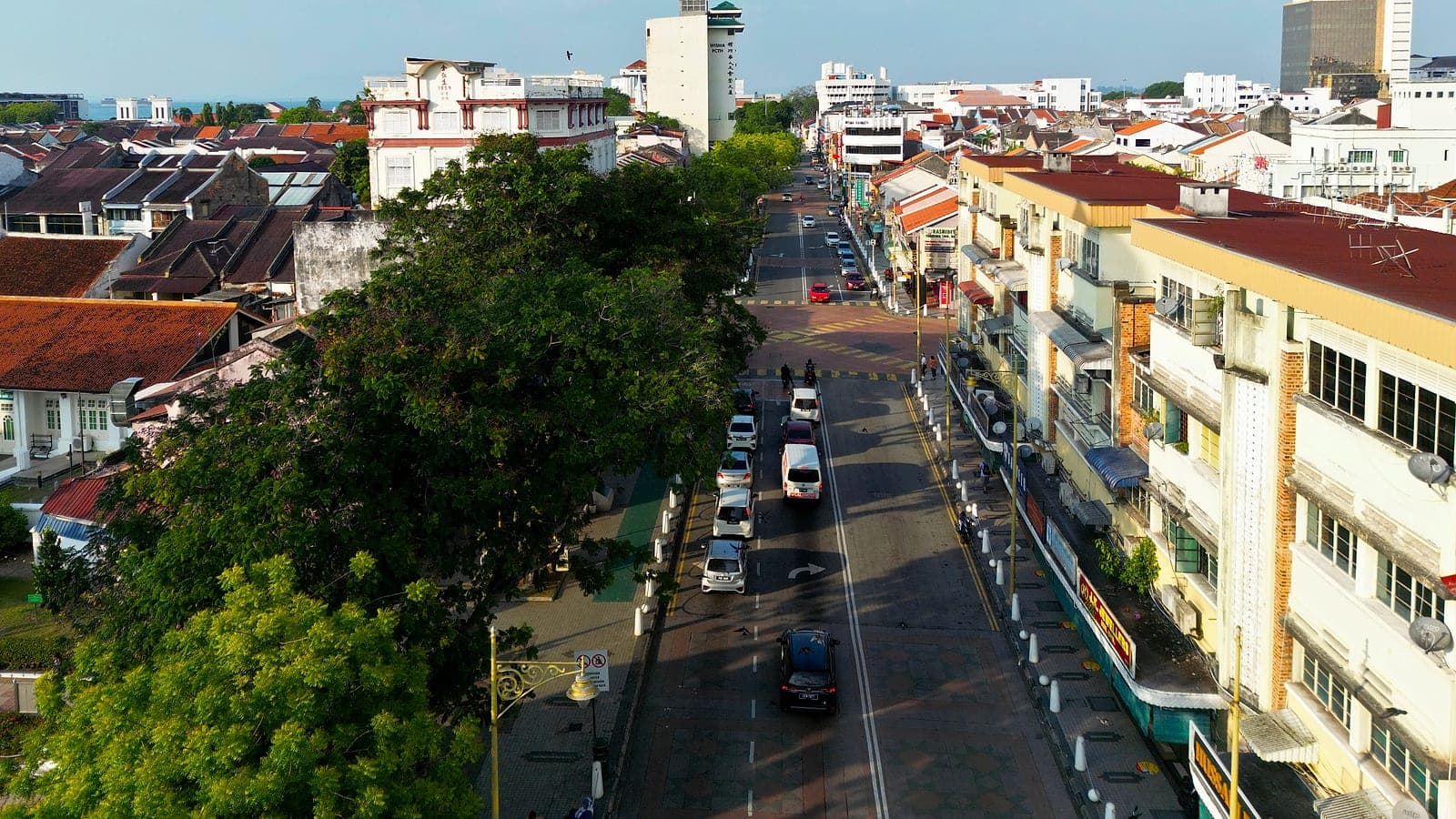
Penang has its own dialect of English — technically a variety of Malaysian English (Manglish) with a heavy Hokkien Chinese substrate — and conversations on the island regularly mix four or five languages in the same sentence without anyone finding it unusual. A coffee shop order might be in Hokkien. A complaint might switch to Malay mid-sentence. The bill calculation happens in Cantonese.
For visitors who want to understand what's happening around them — or just order coffee correctly — here are the words that matter.
The Coffee Shop Vocabulary
Penang's coffee shop (kopitiam) culture has its own ordering system, inherited from the Hainanese coffee tradition. Getting this right is both practical and a sign of respect.
| You say | You get |
|---|---|
| Kopi | Black coffee with condensed milk (sweet) |
| Kopi O | Black coffee with sugar, no milk (O = Hokkien for "black") |
| Kopi O Kosong | Black coffee, no sugar, no milk (Kosong = Malay for "empty") |
| Kopi C | Coffee with evaporated milk and sugar (C from "Carnation") |
| Kopi Ais | Iced coffee (with condensed milk) |
| Teh | Tea with condensed milk |
| Teh O | Black tea with sugar |
| Teh Tarik | "Pulled" tea — poured between two cups from height to create froth |
| Milo Ais | Iced Milo (chocolate malt drink) — technically not coffee but order confidently |
The suffix system is consistent: O = black, C = evaporated milk, Ais = iced, Kosong = no sugar. Once you know the matrix, you can order anything.
How to actually order
Don't say "medium latte." Point at the menu, say the drink name, and state your preference: "Kopi O, satu" (one black coffee with sugar). Locals speak fast and soft — listen for the rhythm rather than individual words.
The Food Words
Char — stir-fried. Char kway teow = stir-fried flat rice noodles. Char siu = barbecued pork.
Mee — noodles (Hokkien/Malay). Mee goreng = fried noodles. Hokkien mee = prawn noodle soup (in Penang — different dish in KL).
Nasi — rice (Malay). Nasi lemak = coconut rice with sambal. Nasi kandar = rice with multiple curries.
Kway teow / kuay teow — flat rice noodles (Hokkien).
Laksa — noodle soup. Penang laksa = sour fish-based broth (asam laksa). Not the same as KL/Singapore laksa (coconut-based).
Cendol — a dessert of shaved ice with pandan jelly, coconut milk, and palm sugar syrup. Always a welcome word.
Banjir — Malay for "flood." At nasi kandar stalls, asking for banjir means you want all the curry gravies poured over your rice. The correct answer to "want banjir?" is always yes.
Chilli padi — small Thai/bird's eye chilli. Very hot. Found at every table in a small dish with soy sauce. Do not assume it is mild.
The Social Words
Lah — a Singaporean/Malaysian particle that softens or emphasises a statement. "It's fine lah." "Come lah." No direct translation; learn it by feel.
Mah — a particle that asserts something is obvious. "Of course mah." Use with confidence once you understand the tone.
Wah — an exclamation of surprise, admiration, or emphasis. "Wah, so big!" entirely positive. "Wah lau" = an expression of exasperation or disbelief (literally "Oh my father!" — toned down from the original).
Alamak — a Malay exclamation of surprise, distress, or mild horror. Universal. Used by all communities.
Shiok — Hokkien/Singlish for extremely pleasurable, satisfying. "This char kway teow is damn shiok." The highest food compliment available.
Steady lah — you've done well. A compliment from a local.
Boleh — Malay for "can." The answer to most questions. "Can we eat here?" "Boleh." Conversely, "Tak boleh" = cannot.
Directions and Getting Around
Jalan — Malay for road/street. Jalan Penang = Penang Road. Used in all addresses.
Lorong — Malay for lane or alley. GPS-resistant: lorongs within lorongs are common in George Town.
Taman — Malay for garden or residential estate. Usually appears before estate names: Taman Bukit Gambier.
Lebuh — a slightly wider road, historically. Lebuh Chulia = Chulia Street in George Town's backpacker belt.
Pekan — town centre or market area.
Balik kampung — "going home to the village." Said by everyone around major Malaysian public holidays (Hari Raya, Chinese New Year). Means roads will be terrible.
The George Town Heritage Terms
Shophouse — a two-to-three-storey building with a covered walkway (five-foot way) at street level and residence or business above. The defining built form of George Town. Chinese-built, colonial-era regulation.
Five-foot way / kaki lima — the covered pedestrian walkway under shophouse overhangs. Five feet wide by colonial regulation. Still used as an informal public space: hawker stalls, motorcycle parking, sleeping.
Clan house / kongsi — a meeting hall for a Chinese clan or surname association. George Town has many, including the Khoo Kongsi (open to visitors) and the Cheah Kongsi. Built as community governance, welfare, and religious centres for immigrant communities.
Peranakan / Nyonya / Baba — the Straits-born Chinese community: descendants of early Chinese immigrants who intermarried with local Malays, producing a hybrid culture with its own cuisine, dress, language, and visual style. Baba = male, Nyonya = female. Nyonya food = Peranakan cuisine, one of Malaysia's most distinctive.
UNESCO zone — shorthand for George Town's UNESCO World Heritage Area, inscribed in 2008. The core zone covers ~109 hectares of the oldest part of the city.
Penang Hokkien Phrases
Penang Hokkien is a southern Min Chinese dialect spoken by the majority of George Town's Chinese population. You don't need to learn it, but these phrases will get a smile:
Hor boh? — Right? / Isn't that so? A conversation-ender that invites agreement. The correct response is "Hor!" (Right!).
Wa liau — I'm done / I give up / that's too much. Said with affection.
Jiak pa beh? — Have you eaten? The standard Hokkien greeting, equivalent to "how are you?" The correct answer is always "Jiak pa liao" (I've eaten already) even if you haven't.
Pah chik nang — never mind / doesn't matter. Useful.
The language you'll actually hear
George Town's street language is a rolling mix. A typical sentence from a hawker: "Wah, that one shiok lah, you try boleh? Confirm liao one." Translation: "That's really good, you should try it. Definitely." Don't try to decode it word by word — listen to the intent.
Getting even a few of these words right earns genuine warmth from locals. Penangites are proud of their food culture and language — any gesture toward understanding it is noticed.
Ordering at a Hawker Stall: A Real Scenario
You arrive at a busy hawker centre — say, Gurney Drive Hawker Centre in the evening. You spot a char kway teow wok smoking nearby. Here's how the exchange actually goes:
You: "Char kway teow, satu." (One char kway teow.)
Hawker: "Mau egg boh?" (Want egg?)
You: "Mau." (Yes, want.)
Hawker: "Spicy boleh?" (Can take spicy?)
You: "Sikit sikit." (A little bit.)
The hawker nods, you step back. You sit down. Food arrives. You try it.
You: "Shiok lah!" (It's delicious!)
The hawker smiles. Transaction complete. Now you want nasi kandar. You walk to the next stall.
You: "Nasi kandar, banjir." (Rice with all the curries poured over.)
Hawker: "Mau ayam ka ikan?" (Want chicken or fish?)
You: "Ayam." (Chicken.)
After eating, you catch the hawker's eye.
You: "Berapa?" (How much?)
Hawker: "Lima ringgit." (Five ringgit.)
You hand over a RM10 note. Change appears. You say "Terima kasih" (thank you). Hawker says "Sama-sama" (you're welcome). You've done it.
For the full story on where to find these dishes and which hawker centres are worth the queue, the Penang food guide covers everything. And if you want a day-by-day itinerary that puts these stalls in order, the itinerary planner does exactly that.
Keep reading
Guides that pair well with this one.
George Town Walking Guide: Routes, Neighbourhoods & Tips for First-Timers (2026)
How to walk George Town for your whole stay — five named loops covering heritage, street art, food, clan houses, and the colonial waterfront, plus heat and shade-hopping tips.
10 min readpracticalPenang Currency and Cash Guide
The Malaysian Ringgit, where to exchange it, how much cash to carry, and whether you need cash at all. Updated for 2026.
3 min readpracticalPenang SIM Card Guide 2026
Where to buy a SIM card in Penang, which network to choose, and how much data you actually need for a week. Updated for 2026.
3 min readpracticalPenang Taxi and Grab Guide
Grab is the right way to get around Penang. Here's what it costs, where taxis still make sense, and how to get from the airport to George Town without getting ripped off.
3 min read