On this page
Vegetarian & Vegan Food Guide to Penang (2026)
Penang has one of the strongest vegetarian food traditions in Southeast Asia — a century-old Chinese Buddhist vegetarian scene, South Indian pure-veg restaurants, and a newer plant-based cafe layer.
Penang has a reputation as one of Southeast Asia's great food cities. What is less often advertised is that it is also one of the most genuinely workable cities in the region for travellers who don't eat meat. This is not a recent development — it is structural.
Three parallel traditions, each over a century old, have made Penang's vegetarian food scene unusually robust: Chinese Buddhist vegetarianism operating strict pure-veg restaurants since the 19th century, South Indian Tamil cooking that brought banana leaf rice and dosa to Penang's streets, and a growing layer of explicitly plant-based cafes catering to Western-influenced eaters. Together they create a situation where going hungry as a vegetarian in George Town is not a realistic concern.
Vegans have a harder time — the hurdles are real and worth knowing about before you arrive — but even then, Penang's Buddhist vegetarian restaurants take you most of the way there.
Penang's Chinese Buddhist and South Indian vegetarian scenes together cover the full range from hawker stalls to sit-down restaurants. Vegetarians eat well here without effort. Strict vegans need a slightly more deliberate approach, but the infrastructure exists — particularly in the Chinese Buddhist restaurant cluster and the newer specialty cafes of George Town.
Vegetarian and vegan travellers who want to know what they can actually eat in Penang — not just reassurance that 'there are options', but a practical map of what the traditions are, where the safe choices are, and where the traps are
Why Penang Is Different
Most Southeast Asian cities have vegetarian food if you look for it. Penang is different because vegetarianism is not an import — it predates modern food tourism by well over a century.
Chinese Buddhist vegetarianism is the oldest tradition. Penang's Hokkien and Teochew communities brought Buddhist dietary practice from the Fujian and Guangdong coast, including the strict prohibition on meat, fish, and eggs, and — in the strictest tradition — the five pungent vegetables (onion, garlic, chives, leeks, and spring onions, believed to agitate the mind). Chinese Buddhist restaurants, called chai thng stalls in Hokkien, are not health food restaurants. They are religious institutions that happen to serve food. The cooking is elaborate, the mock meat tradition is centuries old (char siu made from wheat gluten, "fish" from tofu skin and seaweed, "pork ribs" from mushroom), and the food is genuinely good — not good-for-vegetarian-food, just good.
South Indian vegetarianism is the second tradition. The Tamil community that settled Penang from the early 1800s brought a pure-vegetarian South Indian culinary tradition — banana leaf rice with multiple curries, idli and dosa and vadai for breakfast, sambar, rasam, chutneys — that has operated here continuously since the colonial era. These are not adaptations for a local audience. They are the genuine article, unchanged.
Plant-based cafes are the newest layer — Western-influenced, explicitly labelled, targeting health-conscious and ethically motivated eaters. These are concentrated in the creative quarters of George Town near Armenian Street and Love Lane, and they tend toward smoothie bowls, grain salads, and cafes that serve oat milk without you having to ask.
The result is that a vegetarian in George Town has access to three completely different culinary traditions, all operating at full volume, before leaving a two-kilometre radius.
The Chinese Buddhist Vegetarian Scene
Buddhist vegetarian restaurants in Penang are recognisable by yellow banners — the colour of Buddhism — and by the absence of any animal product on the menu. No meat, no seafood, no eggs. In the strict tradition, no onion or garlic either.
What they do serve is one of the most developed mock meat cuisines in the world. Char siu made from seitan. Tofu skin rolled and seasoned to approximate the texture and colour of roast pork. Mushroom-based dishes designed to carry the weight and savour of meat dishes without any animal input. These are not apologies — they are technically accomplished cooking that Chinese Buddhists have been refining for generations.
The lunar calendar system is worth knowing. Many hawker centres and market stalls that are not usually vegetarian will have additional Buddhist vegetarian stalls operating on the 1st and 15th days of the lunar month — days when Buddhist practitioners traditionally observe a vegetarian diet. On these days, the number of Buddhist stalls at a given market can double. If your visit coincides with one of these dates, the selection at wet markets and coffee shops expands noticeably.
The best concentrations of permanent Buddhist vegetarian stalls are in the morning wet markets of George Town — particularly around Kimberly Street and Chowrasta Market — where they operate alongside regular hawker stalls from around 7am until sold out (typically by noon). These are cash-only, queue-and-point operations, and the pricing is cheap even by Penang standards: a full plate with two or three items over rice runs RM 5–8.
For sit-down Buddhist vegetarian restaurants, George Town's heritage zone has several that open for lunch and dinner. Look for the yellow banner and the absence of Chinese characters relating to meat dishes — if you cannot read the menu, the yellow banner is sufficient.
Buddhist vegetarian and vegan overlap
Chinese Buddhist vegetarian restaurants are close to vegan by default — no meat, no fish, no eggs, and traditionally no dairy (dairy is not part of Hokkien or Teochew culinary tradition). The main exception is mock meat products, which occasionally contain egg white as a binding agent. If you are strictly vegan, ask — the staff at Buddhist restaurants understand the question and can usually tell you which items are clean.
South Indian Pure-Vegetarian Restaurants
The South Indian vegetarian restaurants in Penang's Little India district are the easiest entry point for visitors who want a sit-down meal with no ambiguity. These are pure-veg restaurants — no meat has ever been cooked in them. The menu is familiar to anyone from Tamil Nadu or Karnataka, and fully readable even if you have never been to India.
Georgetown
UNESCO World Heritage Zone
The core of Penang's Indian food district runs along Lebuh Penang (Penang Street) and Lebuh Pasar, between Jalan Masjid Kapitan Keling and Jalan Penang. Sri Ananda Bahwan and the other pure-veg South Indian restaurants are within a short walk of each other here. Come for breakfast (idli and dosa from 7am) or for banana leaf rice at lunch (typically served from 11am until early afternoon, when the leaf rice runs out).
Sri Ananda Bahwan
One of Penang's long-established pure-vegetarian South Indian restaurants, on Lebuh Penang. The banana leaf rice lunch is the right order: a fresh banana leaf laid on the table, topped with plain rice, and then a rotation of three or four vegetable curries, sambar, rasam, and papadom. Refills on rice and curries are offered without asking. Budget RM 10–15 for the full set. Breakfast service covers idli, dosa in several styles, vadai, and pongal. No eggs, no meat, no seafood. Air-conditioned. Busy at lunch — arriving before noon is advisable.
Woodlands Restaurant
In the same neighbourhood, Woodlands is slightly more formal — the kind of pure-veg South Indian restaurant where families go for a proper meal rather than a quick tiffin. The thali is worth ordering: multiple curries served together, balancing sour, sweet, spiced, and plain. The rasam is acidic and peppery in the correct way. Prices are modest — RM 12–20 for a full meal.
Both restaurants are purely vegetarian and have been so continuously. There is no need to specify your requirements or verify dishes — the question does not apply here.
A Note on Roti Canai in Little India
The roti canai stalls on and around Lebuh Penang are operated by Mamak vendors — Indian-Muslim traders whose cooking tradition uses no pork but commonly uses egg (roti telur), butter or ghee, and occasionally lard from Malay suppliers. These stalls are not vegetarian by default. Plain roti canai is often fine, but it pays to ask: "No egg, no ghee?" if you need to be certain. For strict vegans, Mamak stalls are not reliably safe without interrogating each dish.
The pure-veg South Indian restaurants above are the clean option for Indian-style breakfast in George Town.
Hawker Food: What You Can and Cannot Eat
Penang's hawker culture is the thing most travellers come for. The honest answer for vegetarians is: it is navigable, but you need to know the terrain.
The lard problem is real. Many of Penang's most famous hawker dishes are cooked in lard — rendered pork fat — regardless of whether pork meat appears in the dish. Char kway teow is almost always cooked in lard (the wok seasoning is part of the flavour). Hokkien mee uses lard. Wonton noodles use lard. You cannot assume that "no pork" means "no lard." These are different things.
The shrimp paste problem is also real. Rojak sauce, assam laksa broth, and nasi lemak sambal are all typically made with belacan (fermented shrimp paste). The dish may contain no visible seafood while still being built on a shrimp-paste base. At hawker stalls, asking "ada belacan?" (is there shrimp paste?) usually gets an honest answer.
Safe choices at a mixed hawker centre:
- Chinese Buddhist vegetarian stalls — the cleanest option. Look for the yellow banner. Everything is vegetarian and usually close to vegan.
- Indian-operated mamak stalls — no pork, no lard. Roti canai, mee goreng mamak, teh tarik. Verify egg if needed.
- Fresh fruit stalls — universally safe.
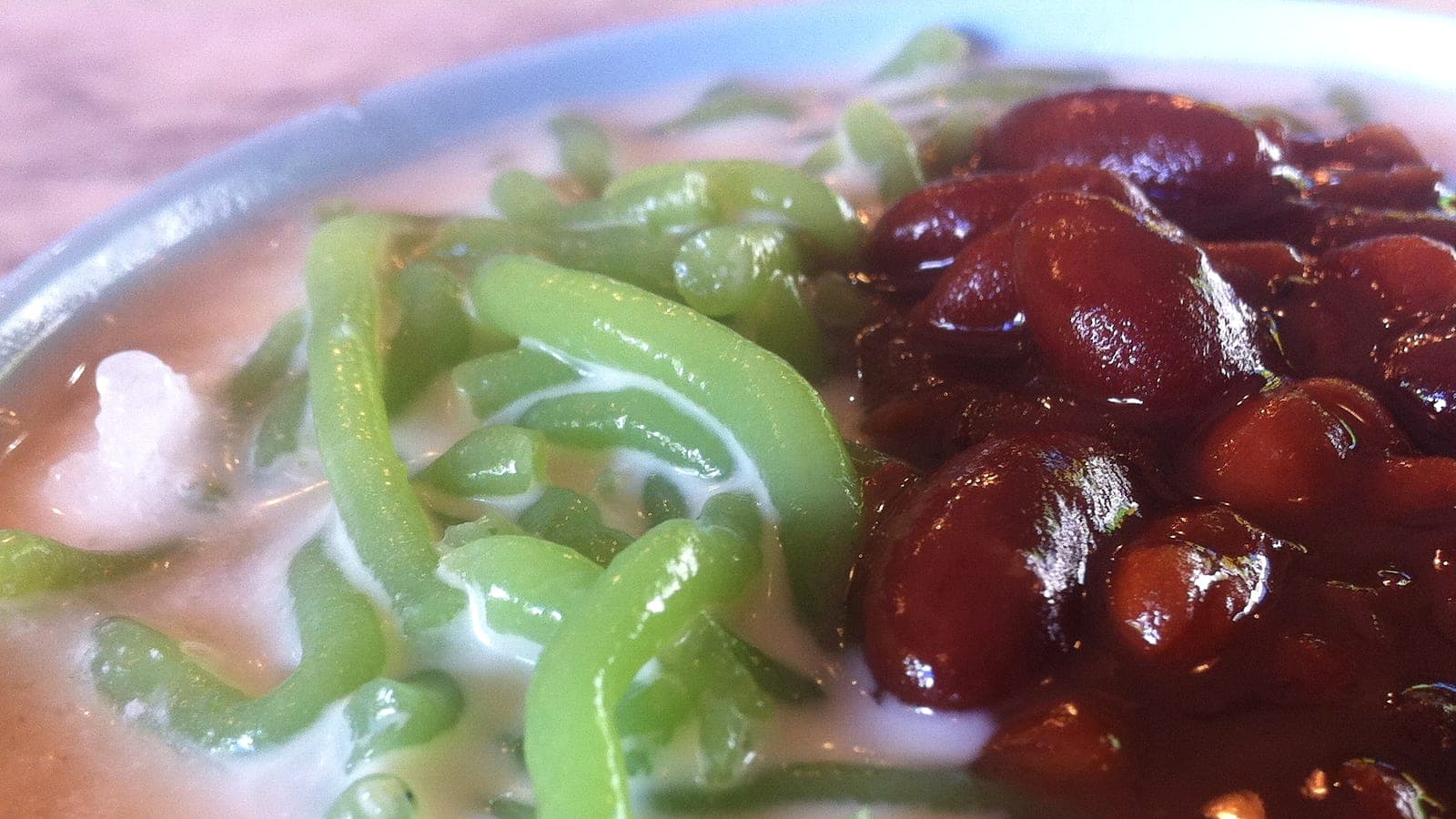
- Ice kacang and cendol — the shaved ice dessert base is fine; the red bean topping is vegetarian; the brown sugar and coconut milk are fine. Check the palm sugar syrup — it is occasionally made with a small amount of anchovy stock in some stalls, though this is not common.
- Curry puffs with potato filling — safe. Curry puffs with sardine filling — not. The filling is usually visible or specified.
Not vegetarian unless confirmed otherwise:
- Char kway teow — lard, egg, sometimes cockles
- Hokkien mee (prawn noodles) — prawn-based broth
- Assam laksa — fish-based broth with shrimp paste
- Nasi lemak sambal — typically anchovy or shrimp paste
- Chee cheong fun sauce — fermented shrimp paste is common
The Halal stall shortcut: Stalls operated by Malay Muslim vendors are required to be pork-free and lard-free by Islamic dietary law. They are not vegetarian (chicken, beef, and seafood are all common), but they eliminate the lard and pork concern. At a Malay stall, you are dealing with meat or no-meat, not hidden lard.
Asking 'no pork' is not enough
At Chinese hawker stalls, "no pork" and "no lard" are different questions. Char kway teow cooked without pork slices may still be cooked in a lard-seasoned wok. If you need to avoid lard entirely, specify: "Tak mahu lard" or "No lard" — most hawkers understand in English. Better yet, order from Chinese Buddhist stalls where the question doesn't arise.
Vegan Specifics
Veganism is harder than vegetarianism in Penang, and it is worth being clear-eyed about why.
Egg is widespread. Soft-boiled eggs are the standard accompaniment to kaya toast in kopitiams (traditional coffee shops). Char kway teow almost always has egg cracked in. Many sweet snacks use egg. If you are avoiding egg, you need to specify at almost every stop.
Dairy in coffee. Kopi (Penang coffee) is traditionally brewed with condensed milk. To get a dairy-free coffee, order "Kopi-O kosong" — black coffee, no sugar, no milk. "Kopi-O" without the "kosong" still means black but often assumes you want it sweetened with sugar. Specify both: black coffee, no milk, no sugar. Specialty cafes in George Town generally stock oat milk without being asked.
Butter in kaya toast. Kaya toast — the classic Penang coffee shop breakfast — uses butter between the toast slices. Some cafes will use margarine on request; most do not have it. This is a minor issue unless you are eating kaya toast every morning.
Chinese Buddhist restaurants are your best vegan resource. The traditional Buddhist vegetarian diet avoids eggs and dairy — these were not part of the Hokkien or Teochew culinary heritage — and most Buddhist vegetarian restaurants in Penang still cook this way. The caveat is mock meat products, some of which use egg white as a binding agent. In a Buddhist restaurant, asking "ada telur dalam ini?" (is there egg in this?) about a specific mock meat item will get you a direct answer.
Specialty cafes in the George Town creative district — around Armenian Street, Love Lane, and the Lebuh Chulia backpacker stretch — increasingly label vegan options explicitly. These are Western-influenced cafes serving smoothie bowls, grain dishes, and coffee with plant milk. The menus are readable, the labelling is honest, and there is no need to interrogate every dish. They are more expensive than hawker food (RM 20–40 per person) but the transparency is valuable.
Useful Phrases
These get you further than "I'm vegetarian" at a Chinese hawker stall or a mixed restaurant:
In Malay:
- "Saya tak makan daging" — I don't eat meat
- "Tak mahu lard" — no lard
- "Ada belacan?" — is there shrimp paste?
- "Ada telur dalam ini?" — is there egg in this?
- "Tak mahu telur" — no egg
In Cantonese/Hokkien (understood at Chinese stalls):
- "Mo yuk" (Cantonese) — no meat
- "Mo lard" — understood as English at most stalls
- "Chai" — vegetarian (understood at Buddhist stalls)
In English:
- "Pure vegetarian" — understood at Indian restaurants and Buddhist restaurants without further explanation
- "No meat, no fish, no egg, no dairy" — understood at specialty cafes
- "No pork, no lard" — understood at Chinese hawker stalls (gets you halfway there)
At South Indian pure-veg restaurants, no phrase is necessary — the question doesn't apply to the menu.
Planning Your Food Days
For vegetarians (not strictly vegan):
Eating in Penang requires no special planning. Use South Indian restaurants for sit-down meals — banana leaf rice at lunch is one of the best-value meals in the city — and Chinese Buddhist stalls at hawker centres. Specialty cafes handle breakfast and coffee. The infrastructure is dense enough in George Town that you are never more than a short walk from a reliable option.
For strict vegans:
Plan your main meals around Chinese Buddhist restaurants — these are the most reliable vegan option in the city and are genuinely good eating, not a compromise. Use specialty cafes for breakfast and coffee. At mixed hawker centres, stick to Buddhist stalls and fresh fruit. The main gap is late-night eating — Buddhist restaurants typically close by 9pm and specialty cafes by 10pm. For late meals, mamak stalls (Indian-Muslim) offer roti canai and mee goreng that can be made egg-free on request, though cross-contamination with non-vegan items is possible.
The honest summary: Vegetarians do not need to worry about food in Penang. Vegans need a slightly more deliberate approach — know which restaurant types to anchor on, know the phrases, and the city is workable. Going hungry is not a risk in either case, provided you are staying in or near George Town.
For the broader food landscape — where to eat, what to order, and how the different hawker cultures connect — the Penang food guide covers the full picture. The halal food guide is useful context for understanding which stalls are operated by Malay Muslim vendors (and therefore lard-free) at mixed hawker centres.
Keep reading
Guides that pair well with this one.
Best Hawker Centres in Penang: Where Locals Actually Eat (2026)
Penang's hawker centres range from tourist-facing esplanade spots to residential courts where nobody speaks English and the food is better. Here's how to navigate both.
8 min readfoodPenang for Food Lovers: The Complete Eating Guide
The definitive guide to eating in Penang — from dawn hawker breakfasts to late-night char kway teow. Where to eat, what to order, and the unwritten rules of the hawker centre.
8 min readfoodPenang Coffee Guide: Kopitiams, Local Roasters & What to Order (2026)
Penang has two parallel coffee cultures — the century-old kopitiam tradition and a newer specialty scene. Both are worth your time, for different reasons.
11 min readfoodPenang Food Streets Guide: The Best Hawker Streets & Lanes (2026)
A street-by-street guide to Penang's best hawker lanes — Kimberley Street, Gurney Drive, Penang Road, Lorong Baru (New Lane) and the lesser-known local streets worth finding.
7 min read