On this page
Penang's Most Important Heritage Buildings: A Visitor's Guide (2026)
From the Blue Mansion to Khoo Kongsi to Fort Cornwallis — Penang's key heritage buildings, what each one is, how to visit, and what makes it worth your time.
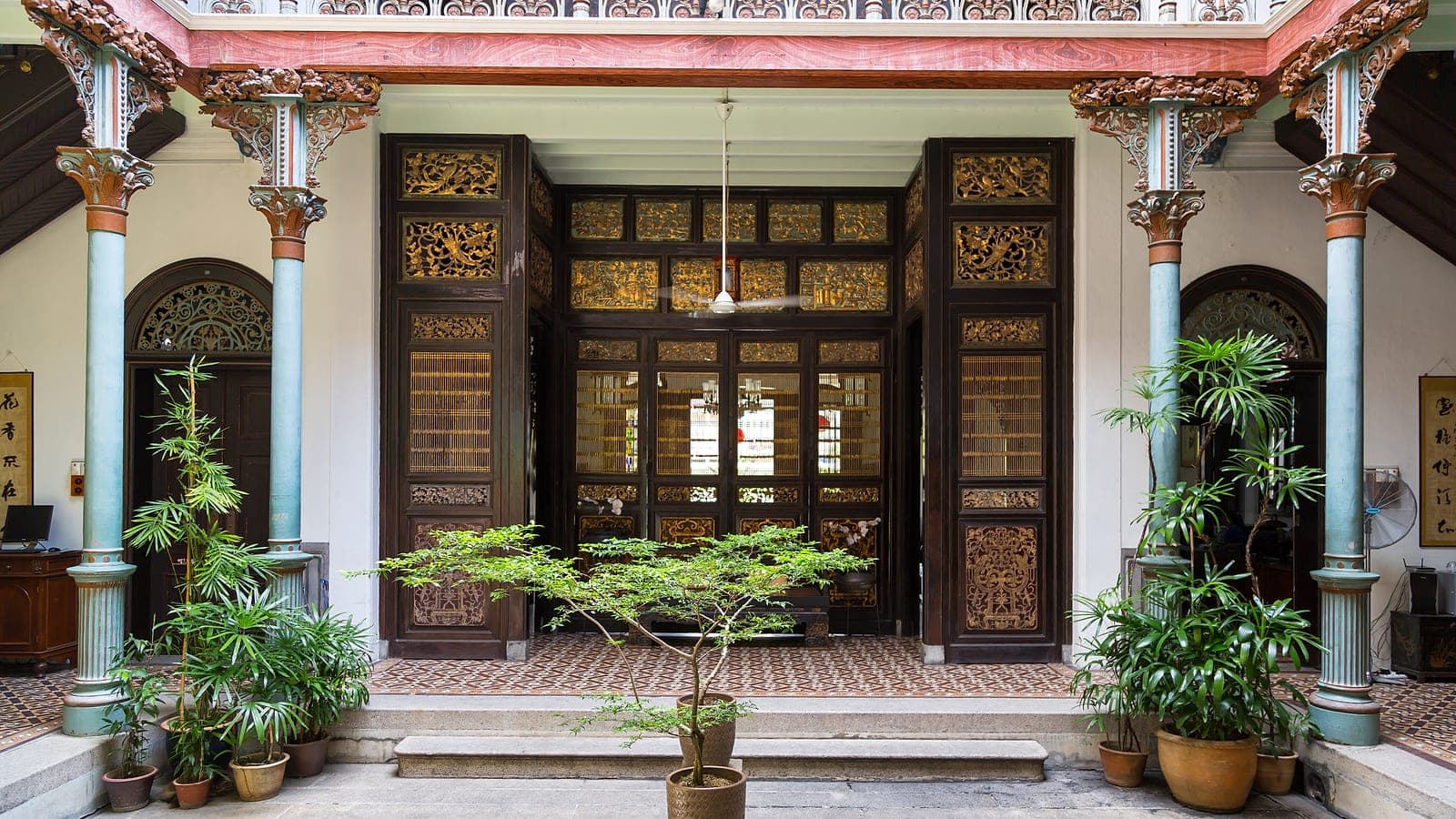
George Town has one of the most intact collections of pre-war buildings in Southeast Asia. Most visitors see the heritage zone as a pleasing backdrop — old buildings, nice streets — without knowing which specific structures are significant, or why. This guide covers the buildings that reward close attention: what they are, who built them, what happened to them, and the practical details for visiting each one.
Penang's heritage buildings span four distinct communities — British colonial, Peranakan Chinese, Chinese clan associations, and Malay Islamic — each with its own architectural logic. The most important examples are within 2km of each other in the George Town core. Most are open to visitors with modest entry fees; some are still operating buildings (hotels, active temples) that welcome visitors alongside their regular function.
Culture-focused visitors who want to understand the specific buildings in George Town, not just walk past them — including entry costs, tour times, and what each building represents in Penang's history
Cheong Fatt Tze Mansion (The Blue Mansion)
Address: 14 Leith Street, George Town
Tours: Daily at 11am and 3pm. Duration 45–50 minutes.
Entry: RM17 (adult)
Also: Boutique hotel with 16 rooms — overnight guests have access beyond the tour areas
The Blue Mansion is the most architecturally significant private building in George Town. It was built between 1880 and 1904 for Cheong Fatt Tze (Chang Pi-Shih in Mandarin), a Hakka merchant who arrived in Penang from southern China in the 1850s with minimal capital and became, by his death in 1916, one of the wealthiest men in Asia — with businesses spanning rubber, tin, banking, and trading across Southeast Asia and China.
The building is a Chinese courtyard mansion — seven halls, seven courtyards — built using craftsmen brought specifically from Guangdong Province. The spatial logic is traditional Chinese: a central axis from the entrance gate through successive halls and open sky wells, with flanking wings for family quarters and servants. But the decorative language is mixed: French Art Nouveau cast-iron work on the balustrades, Scottish floor tiles, Qing Dynasty carved screens, and English-style louvred shutters at the windows. The result is the Straits Chinese Eclectic style at its most confident.
The indigo blue of the exterior — the source of the "Blue Mansion" name — was not the original colour. Restoration in the 1990s involved significant research to rediscover the original shade, which uses a natural pigment (indigo-based) not available from commercial paint suppliers. The specific formula was reconstructed through analysis of surviving paint samples.
What the tour covers: The ground floor halls and main courtyard are accessible on the standard tour. The guide explains the courtyard feng shui, the construction techniques (no nails in the structural timber), the Cheong family history, and the 1995–2000 restoration. The tour does not access private residential areas.
Pinang Peranakan Mansion
Address: 29 Church Street, George Town
Hours: Daily 9:30am–5pm (last entry 4:30pm)
Entry: RM20 (adult), RM10 (child)
Guided tours: Available with advance booking; self-guided audio tour available
The Pinang Peranakan Mansion is the reference museum for understanding Baba-Nyonya (Peranakan) culture in Penang. The Baba-Nyonya community — descendants of Chinese immigrants who settled in the Straits Settlements from the 15th century onwards and adopted Malay language and customs while retaining Chinese religion and values — developed a distinct material culture that the mansion documents through its original furnishings, objects, and architecture.
The building itself was the home of Chung Keng Quee (Zheng Jingui), a Hakka towkay (business leader) and leader of the Ghee Hin secret society who became the most powerful Chinese figure in 19th-century Penang. The scale of the structure reflects his position: the main hall is 3.5 storeys high with a central air well, and the building originally extended significantly further back than the public section.
What to see inside: The collection spans over 1,000 artefacts in their original or reconstructed room settings. The most striking rooms: the formal reception hall with its carved Qing Dynasty furniture and Nyonya beaded accessories; the dining room with Victorian-era English porcelain alongside Chinese export ware; the bridal chamber with its elaborate Peranakan wedding textiles and jewellery. The tile floors — a mix of British encaustic tiles and hand-painted Portuguese tiles — are among the finest surviving examples in the region.
Practical note: Photography is allowed in most areas. The building is not air-conditioned; bring water and plan visits for the morning or late afternoon when it is coolest.
Khoo Kongsi
Address: Cannon Square, off Lebuh Cannon, George Town
Hours: Daily 9am–5pm
Entry: RM10 (adult), RM5 (child). The outer square and clan streets are free to walk.
A kongsi is a clan association — a mutual aid organisation for Chinese immigrants sharing the same surname. The Khoo clan (descendants of families with the Hokkien surname Khoo/Khu) built the first temple on this site in the 1850s. The current structure, completed in 1906 after the original burned in 1894, is one of the most ornate clan temples in Malaysia and the defining example of Penang's kongsi architecture.
The scale of the complex was originally even larger. After the first temple burned — widely interpreted as divine retribution for the clan's excessive grandeur — the reconstruction was deliberately scaled back. The current building, despite this reduction, remains richly decorated: 12 granite pillars carved with writhing dragons, an elaborate roof ridge with colourful ceramic figurines, and interior murals depicting scenes from Chinese history and mythology.
What makes it distinctive: The juxtaposition of the temple's grandeur with the surrounding clan housing (some of it still occupied by Khoo clan members) creates a functioning living heritage precinct. Walking Cannon Square and the surrounding clan lanes — Khoo clan houses on one side, the temple on the other — is the best way to understand how Penang's Chinese community organised its urban life around the clan system.
The clan street system: The area around Khoo Kongsi was historically a clan enclave — families living in houses that could be accessed from the lane in front of the kongsi but not from the public streets. This controlled entry arrangement was a security and community feature. The lane structure partially survives.
Fort Cornwallis
Address: Jalan Tun Syed Sheh Barakbah (Esplanade), George Town
Hours: Daily 9am–7pm
Entry: RM20 (adult)
Fort Cornwallis marks the founding point of British Penang. Francis Light landed on the northeastern tip of the island in August 1786, cleared the jungle, and built an initial stockade — the origin of the name "Fort Cornwallis" from the Governor-General of India, Lord Cornwallis, who gave the colony its formal backing.
The current star-shaped brick fortification dates from 1810; the original was timber. The star-fort plan — five pointed bastions radiating from a central yard — was the standard European military fortification design of the late 18th century, effective against cannon fire by presenting angled surfaces rather than flat walls. The fort never fired its cannons in anger; Penang was a trading post, not a garrison.
What survives: The outer walls are largely intact. Inside the fort: a small museum with panels on Penang's founding and the Light family; the original chapel (St Francis Xavier's, 1799, the earliest Christian structure in Penang); and the bronze cannon Seri Rambai, which has its own story — cast in the Netherlands in 1603, captured by Portuguese, used by the Achenese, brought to Penang by the Dutch, and now a fertility object surrounded by flowers and offerings from childless women who pray at it.
Practical note: The fort's interior can be covered in 45 minutes. The real value is the adjacent Esplanade — the wide foreshore park along the waterfront, one of the few green spaces in the George Town core, with views to Province Wellesley and good evening light.
Kapitan Keling Mosque
Address: Jalan Masjid Kapitan Keling (off Lebuh Chulia), George Town
Hours: Open to visitors outside prayer times. Friday midday closed during Jumu'ah prayers.
Entry: Free. Modest dress required — robe available at entrance.
The Kapitan Keling Mosque is Penang's most important and historically significant mosque, built around 1800 and substantially rebuilt and expanded several times since. The "Kapitan Keling" name refers to the leader (kapitan) of the Keling community — the term used by Malays for Tamil-speaking Indians — who funded the original construction. The mosque's association with the Tamil Muslim (Jawi Peranakan) community reflects Penang's layered immigrant history.
The current structure's architecture is Mughal influenced, with the characteristic onion dome and arched cloisters. The mosque is still an active place of worship with a significant congregation; it is also one of the most-visited heritage sites in George Town by non-Muslim visitors who come to see the architecture.
Visiting etiquette: Dress modestly — covered shoulders, covered knees for both men and women. Robes are provided at the entrance for those in shorts or sleeveless clothing. Remove shoes before entering the covered prayer area. Women entering the prayer hall should cover their hair — headscarves available at the entrance. Photography of the exterior and courtyard is generally fine; check with the caretaker before photographing the interior prayer space.
Sri Mahamariamman Temple
Address: Jalan Masjid Kapitan Keling (adjacent to the Kapitan Keling Mosque), George Town
Hours: Daily 6am–9pm
Entry: Free
One of the oldest Hindu temples in Penang, the Sri Mahamariamman Temple was established in the early 19th century to serve the Tamil Hindu community — primarily labourers brought to Penang and the surrounding region for the colonial economy. The temple's primary deity is Mariamman, a south Indian goddess associated with rain, fertility, and disease prevention.
The temple's exterior gopuram (tower) is covered in brightly painted stucco figures — gods, mythological scenes, protective deities — in the south Indian Dravidian style. The colour and density of these figures is deliberately exuberant: in Hindu temple architecture, more figures indicates more divine protection.
What to see inside: The main shrine hall contains the primary deity figure attended by priests who conduct regular puja (offerings and prayer). The side shrines for Ganesha and other deities are smaller but equally ornate. The temple is actively used — you will likely see worshippers conducting puja, and priests performing ceremonies throughout the day.
Thaipusam: The temple is the starting point of the annual Thaipusam procession in Penang (typically January/February), when devotees carry kavadi (elaborate metal frames with skewers piercing their skin as acts of devotion) in a procession to the Waterfall Temple. The procession draws hundreds of thousands of participants and observers.
George Town's Clan Jetties
Address: Weld Quay, George Town (follow signs from the waterfront)
Hours: Accessible at all times (the jetties are lived-in residential areas)
Entry: Free
The Clan Jetties are not buildings in the conventional sense — they are communities of houses built on wooden piles over the sea, accessed by narrow wooden boardwalks extending from the shoreline. There are seven jetties, each historically associated with a Chinese clan surname.
Chew Jetty (Jeti Chou): The largest and most visited. A Chinese temple at the end of the boardwalk, souvenir stalls, heritage plaques, and several coffee stalls. The clan houses that remain are a mix of historic and modern materials — wooden frames patched with corrugated iron, new concrete additions alongside original timber structures.
Lim and Tan Jetties: Quieter and less visited than Chew Jetty. The Tan Jetty in particular retains more of the working-port character without the souvenir infrastructure.
What to understand: The jetties are still inhabited — residents live here, hang their laundry, park motorcycles on the boardwalk, and generally do not exist for the benefit of tourism. Walk respectfully, do not enter houses, keep noise down in the residential sections.
Visiting Multiple Buildings in One Day
A practical sequence that covers the major sites without rushing:
Morning (9am–12pm): Khoo Kongsi clan temple + clan streets (1hr) → Pinang Peranakan Mansion (1.5hr) → walk through Armenian Street to Kapitan Keling Mosque (20 min) → Sri Mahamariamman Temple (30 min)
Midday: Lunch at a nearby hawker centre or kopitiam
Afternoon (2pm–5pm): Blue Mansion tour at 3pm (1hr) → Fort Cornwallis (45 min) → Clan Jetties at Weld Quay (45 min) → Esplanade waterfront walk
This covers all seven major heritage buildings in one day with reasonable pacing. Entry fees total approximately RM65–70 per adult.
Keep reading
Guides that pair well with this one.
Penang Architecture Guide: Shophouses, Colonial Mansions & Heritage Streets (2026)
George Town has more surviving pre-war architecture than almost any city in Southeast Asia. Here's how to read the buildings — what each style means, and which streets are worth walking.
8 min readculturePenang Temple Guide: Kek Lok Si, Sri Mahamariamman & More (2026)
A guide to Penang's major temples — Buddhist, Hindu, Taoist, and the multi-faith harmony of Pitt Street. Opening hours, dress codes, and what to actually look for.
7 min readneighborhoodsArmenian Street George Town — Complete Guide
Lebuh Armenian is the most-photographed street in Penang. Here's what's actually on it, what's nearby, and how to see it without just following the mural trail.
7 min readpracticalGeorge Town Walking Guide: Routes, Neighbourhoods & Tips for First-Timers (2026)
How to walk George Town for your whole stay — five named loops covering heritage, street art, food, clan houses, and the colonial waterfront, plus heat and shade-hopping tips.
10 min read