On this page
Penang for Chinese Tourists: What to Know Before You Visit (2026)
A guide for Mandarin-speaking visitors from mainland China, Taiwan, and Hong Kong — Penang's Chinese heritage, language, food connections, visa requirements, and what makes it worth the trip.
Penang holds a specific place in Chinese diaspora history. When the British established the port in 1786, Hokkien-speaking traders and labourers from Fujian province were among the first significant communities to arrive. Over the following century, Penang became one of the most important overseas Chinese settlements in Southeast Asia — a community that developed its own dialect, cuisine, architecture, and cultural synthesis.
For travellers from mainland China, Taiwan, and Hong Kong, Penang is not a generic Southeast Asian destination. It's a place with visible Chinese cultural DNA — the clan temples, the Hokkien dialect in the old markets, the shophouse architecture — combined with a creole food culture that diverged from mainland cooking 200 years ago and is now distinctly its own thing.
This guide covers the historical context, language situation, visa requirements, food connections, and key cultural sites. It's specific to the experience of Chinese-speaking visitors rather than a generic Penang overview.
Mandarin-speaking travellers from mainland China, Taiwan, and Hong Kong who want to understand what makes Penang relevant to Chinese history and culture, and what the experience of visiting is like as a Chinese-speaking visitor
The Historical Connection
The Chinese community in Penang is predominantly Hokkien (Fujian-speaking), with significant Cantonese, Teochew, Hakka, and other dialect groups. The major clan associations — the Khoo Kongsi, the Lim Kongsi, the Cheah Kongsi — were established in the 19th century by these communities to provide mutual support, mediate disputes, and maintain connections to home provinces.
The Straits Chinese (Peranakan or Baba-Nyonya) community represents a further layer: Chinese merchants who arrived in Penang and the broader Straits Settlements over multiple generations, intermarried locally, and developed a distinct hybrid culture — adopting Malay language (Baba Malay), clothing, and cooking techniques while maintaining Chinese religious practice and ancestral identity.
This layering — Hokkien base, Peranakan creole layer, and the more recent influx of post-1980s immigrants from various Chinese provinces — makes George Town's Chinese cultural landscape more complex and, for visitors who engage with it, more interesting than a simpler "overseas Chinese" story.
Language
Penang's older Chinese community is predominantly Hokkien-speaking. Cantonese is also widely understood. Mandarin is spoken but is not the primary dialect of the old community.
For mainland Chinese visitors — You will be understood in Mandarin at hotels, tourist-facing businesses, and many shops throughout George Town. At the oldest traditional businesses and clan temples, Hokkien may be the more comfortable language for older residents.
For Taiwanese visitors — The Hokkien dialect in Penang (Penang Hokkien) is mutually intelligible with Taiwanese Hokkien at a basic level, though there are vocabulary differences and the Penang version has absorbed Malay loanwords. This linguistic bridge is sometimes a point of connection and interest for Taiwanese visitors.
For Hong Kong visitors — Cantonese is understood at many heritage businesses. The Cantonese community in Penang established its own institutions (the Cantonese Clan Association, the Cantonese section of the Penang Chinese Town Hall).
Practical point — English works throughout Penang's tourist areas. Don't rely only on Chinese language ability; Malay is the national language, English is the commercial language, and dialect Chinese is the old community language.
Visa and Entry
Mainland Chinese passport holders — Malaysia has extended visa-free access to China nationals for tourism stays of up to 30 days (confirm current status before travel as this has been subject to revision). Check with the Malaysian High Commission or VFS Global for the current status at time of travel.
Taiwan passport holders — Visa-free entry for 30 days.
Hong Kong SAR passport holders — Visa-free entry for 30 days.
Confirmation recommended — Visa policy between China and Malaysia has been subject to updates; confirm current requirements at the Malaysian Immigration Department website (imi.gov.my) before booking travel.
The Clan Temples and Cultural Sites
Khoo Kongsi — The most significant clan temple in Penang, built by the Khoo clan from Fujian province. The current building dates to 1906 (reconstructed after a fire), with elaborate carved and gilded facades in the southern Chinese decorative tradition. The adjacent Cannon Square has several smaller clan houses. Entry RM 10. This is the most architecturally impressive clan site in Southeast Asia.
Goddess of Mercy Temple (Kuan Yin Teng) — The oldest Chinese temple in Penang, established in 1728. Still an active place of worship. The incense smoke, the sound of worshippers, and the layered altar arrangements are more immersive than any museum display of the same tradition.
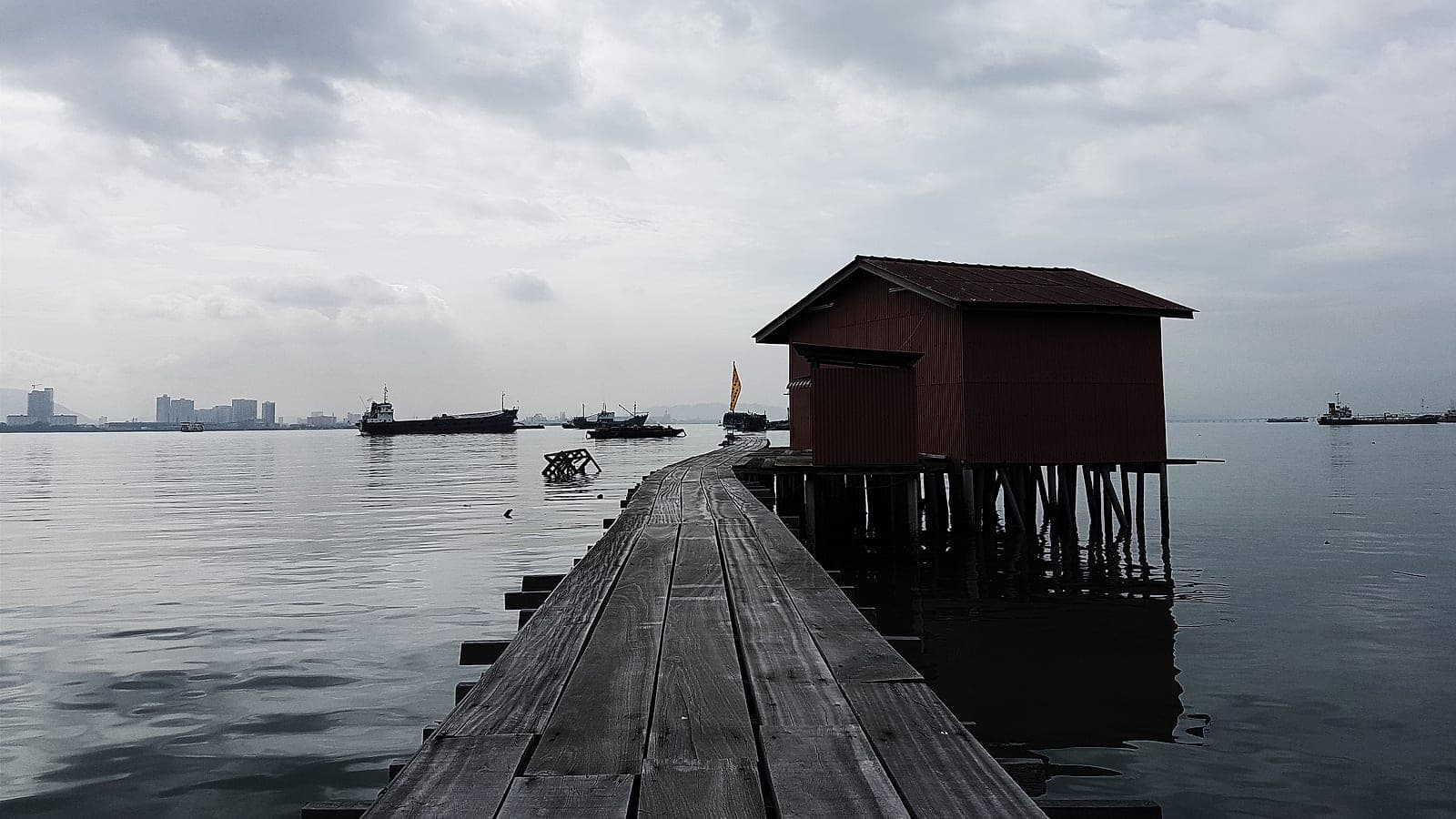
Clan Jetties — The surviving wooden jetty communities at Weld Quay — Chew Jetty is the largest and most visited — were established by clan groups who literally built their houses over the water. The Chew Clan Jetty still functions as a residential community; the visit is a walk through a living settlement, not a museum exhibit. Free entry. Morning or evening are the better times to visit.
Penang Peranakan Mansion — A museum in a restored Peranakan merchant house, with one of the best collections of Straits Chinese furniture, ceramics, silver, and domestic objects in the region. The building itself — the indoor courtyard, the carved partition screens, the gilded marriage bed — is the exhibit. Entry approximately RM 25. Lebuh Gereja (Church Street).
Food: The Connections and Divergences
Penang's Chinese-origin food has diverged significantly from its mainland counterparts. This divergence is the interesting part for food-conscious Chinese visitors.
Hokkien Mee — In Fujian, ban mian (Fujian noodle) is a much simpler dish. Penang Hokkien Mee (locally called Prawn Mee or Hae Mee) has absorbed Malay and Peranakan influences: the broth uses prawn and pork bone in combination, the spicing is different, and the dish is eaten with sambal (chilli paste). The name is the same; the dish is completely different.
Char Kway Teow — The flat rice noodle stir-fry that Penang is most famous for internationally. The technique (wok hei, charcoal heat) has roots in southern Chinese cooking but the specific combination — cockles, Chinese sausage, dark soy sauce, bean sprouts — is specific to Penang. There is no direct mainland equivalent.
Bak Kut Teh — The pork rib soup that is a staple of Klang (near KL) and also found in Penang. The Penang version is spicier and more peppery than the Klang version. Arguably has Hokkien origins, developed in the Malaysian context.
Nyonya food — The Peranakan cuisine of Penang is the most diverged from mainland Chinese cooking: heavy on coconut milk, dried shrimp, tamarind, belacan (shrimp paste), and fresh herbs, using techniques and ingredients that absorbed Malay cooking deeply over 200 years. Asam laksa is the most distinctive example: a sour tamarind and mackerel broth with rice noodles. There is nothing like it in Chinese cuisine.
The food tourism angle here is compelling: these are dishes that share DNA with southern Chinese cooking but are now fully their own tradition. For Chinese visitors with deep food interest, tasting the Penang versions and understanding the divergence is a specific kind of cultural experience.
Getting Around
Mandarin GPS — Baidu Maps and Apple Maps both work in Penang with reasonable accuracy. Google Maps is also functional (Google services are accessible in Malaysia without VPN). The road names in George Town are in English and Malay rather than Chinese characters; knowing the English name of where you're going matters.
WeChat Pay and Alipay — Both are accepted at an increasing number of businesses in George Town, particularly those that cater to Chinese visitors. Not universal; carry ringgit for hawker stalls and markets.
Chinese social media content — Penang is well-covered on Xiaohongshu (Red Note) and Douyin, which is useful for food discovery but creates congestion at the most-photographed spots. For hawker food, the less-photographed stalls are often the better ones.
Practical Considerations
Best time to visit — If you're specifically interested in Chinese New Year in Penang, the festival is significant here — the clan temples are lit up, the streets have lion dances, and the heritage hotels fill up. Book accommodation 2–3 months in advance if visiting in January/February. The rest of the year, Penang's climate is warm and humid; April–May and September–October have higher rainfall but short afternoon showers rather than all-day rain.
Duration — Three nights in George Town is the minimum to eat well and see the heritage sites without rushing. Four or five nights allows for a day trip to Balik Pulau (orchard area, fruit farms, slower pace) or to Langkawi.
Food budget — Hawker meals RM 8–15 per dish. Coffee shops RM 3–8 for drinks. The most famous hawker stalls are not expensive; the total bill for a generous hawker dinner for two is RM 40–70.
Keep reading
Guides that pair well with this one.
Free Things to Do in Penang: A Practical Guide to Exploring Without Spending
The best free activities in Penang — heritage walks, street art, temples, beaches, and markets. Honest about what costs and what genuinely doesn't.
11 min readneighborhoodsArmenian Street George Town — Complete Guide
Lebuh Armenian is the most-photographed street in Penang. Here's what's actually on it, what's nearby, and how to see it without just following the mural trail.
7 min readculturePenang for Art Lovers: Street Art, Galleries, and Living Heritage
Georgetown's street art scene is one of Southeast Asia's most distinctive — murals, wrought-iron caricatures, clan house interiors, and contemporary galleries. This is where to find them and how to see them properly.
7 min readcultureFamous People Connected to Penang — Artists, Scientists, and Revolutionaries
Penang has produced and shaped a surprisingly influential roster of notable people — from the founder of modern China to Nobel-level scientists and award-winning filmmakers. Here's who came from, or was formed by, this island.
6 min read