On this page
Penang Architecture Guide: Shophouses, Colonial Mansions & Heritage Streets (2026)
George Town has more surviving pre-war architecture than almost any city in Southeast Asia. Here's how to read the buildings — what each style means, and which streets are worth walking.
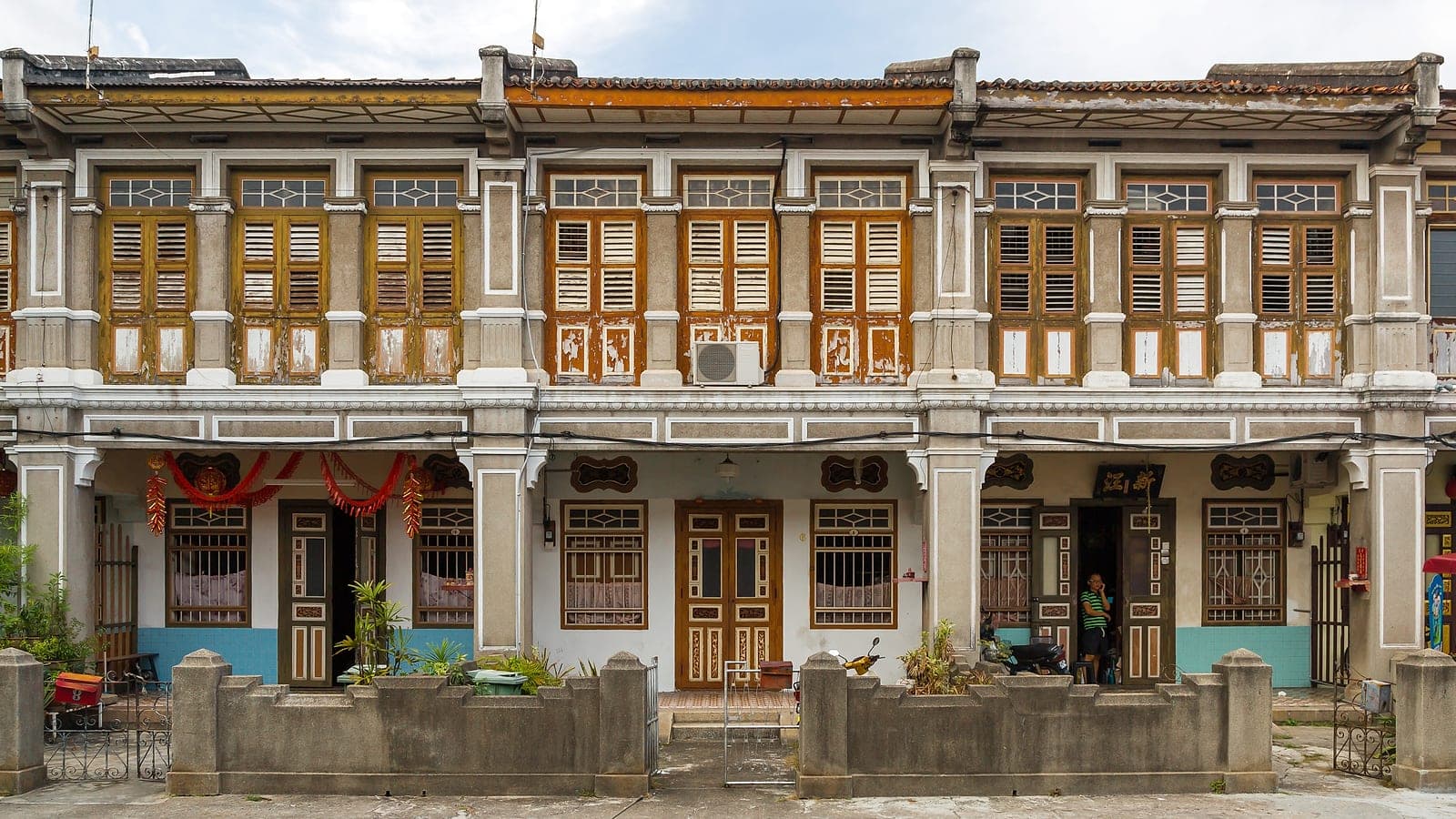
George Town received UNESCO World Heritage Site status in 2008, jointly with Melaka, for its "unique architectural and cultural townscape." The citation is precise: what makes the city distinctive is not individual landmark buildings but the surviving ensemble — row after row of pre-war shophouses on streets where the built environment has not been comprehensively replaced by modern construction.
Most visitors walk through this without understanding what they are looking at. The five-foot-way (the covered pedestrian walkway created by the first shophouse row), the plaster tracery on a Straits Eclectic facade, the ventilation shaft cut through the centre of a Chinese courtyard house — these are not decorative accidents. They are a functional building vocabulary developed over a century to solve specific problems: tropical heat, monsoon rain, dense urban living, and the need to combine commerce and residence in a single structure.
This guide explains what you are looking at when you walk George Town's heritage streets, and which buildings merit close attention.
George Town's pre-war architecture represents five distinct styles layered over 200 years of British, Chinese, Malay, Indian, and Peranakan influence. Understanding even the basics — what a five-foot-way is, how to read a Chinese courtyard house, what Straits Eclectic means — transforms a walk through the heritage zone from pleasant to comprehensible.
Architecture-interested visitors, history enthusiasts, and anyone who wants to understand George Town beyond the surface-level 'old buildings' observation
The Shophouse
The shophouse is the defining building type of George Town. A shophouse is a narrow, deep terrace building, typically two or three storeys, with commercial use on the ground floor and residential use above or behind. The front of the ground floor opens directly to the street through a covered walkway — the five-foot-way, so named because it was legally mandated to be five feet wide.
The five-foot-way system was introduced by Stamford Raffles in Singapore in 1822 and replicated in Penang. The logic: tropical rain and sun make street-level walking miserable if there is no cover. By requiring all ground-floor buildings to set back five feet from the street and cover that setback, the colonial planners created a continuous shaded walkway that runs the length of every shophouse block without requiring coordinated planning between individual property owners.
The result in George Town: you can walk from almost any point in the heritage zone to another in shade, even in heavy rain, as long as you follow the shophouse streets. This is not an accident. It is a 200-year-old piece of pedestrian infrastructure that modern buildings have broken where they replace older stock.
Reading the facade: A shophouse facade from the street tells you its period and style. Key elements:
- Ventilation holes near the roofline are functional, not decorative — they circulate air through the building's depth.
- Plaster ornaments — flowers, vases, animals, geometric patterns — indicate the owner's cultural background and the building's approximate era. Late Qing Dynasty motifs are common on early Chinese shophouses. Art Deco geometry appears from the 1920s onwards.
- Shuttered windows at the upper floor with louvred panels are the primary pre-air-conditioning ventilation system for the residential floors above.
- The door of a traditional shophouse has three layers: a full-height timber door (for security), a half-height door called a pintu pagar (for ventilation and light during business hours), and sometimes a bead curtain inside.
The Five Shophouse Styles
George Town's shophouses fall into five identifiable types, roughly corresponding to periods of construction:
1. Early Style (pre-1850s): Plain facades, minimal ornamentation, Chinese courtyard plan. The ornament budget went to the interior, not the street elevation. The Khoo Kongsi complex on Cannon Square has surviving examples of this type.
2. First Transitional Style (1840s–1900s): European-influenced mouldings applied to Chinese building forms. Pilasters, arched windows, and classical proportions appear, but the spatial plan remains Chinese. Armenian Street and Lebuh Carnarvon have concentrated examples.
3. Southern Chinese Baroque (1890s–1940s): Heavy plasterwork, elaborate ventilation tiles, bright paint colours in restored examples. More commonly called "Straits Eclectic" in heritage literature. This is the dominant style of the George Town core.
4. Art Deco (1920s–1940s): Geometric ornament replaces classical and Chinese motifs. Streamlined facades, porthole windows, sans-serif lettering in plaster. More common in the commercial streets near the waterfront.
5. Late Style (1940s–1960s): Modernist influence — flat roofs, horizontal bands, minimal ornament. Fewer of these survive in the core heritage zone.
The Chinese Courtyard House (Townhouse)
Above the shophouse tier sit the larger private residences of successful merchant families — the Chinese courtyard house, called a tokong (mansion) in local parlance. These are deep courtyard structures that do not show their full extent from the street.
The spatial logic: enter through a gate or street door into a receiving hall. Behind this is a central courtyard open to the sky — the tian jing or sky well — which provides light and ventilation to the rooms flanking it. Behind that, another hall, then another courtyard, extending back as far as the family's wealth permitted.
The key examples open to the public:
- Pinang Peranakan Mansion (39 Church Street): A restored Baba-Nyonya mansion with original furniture, tiles, and objects. The interior demonstrates the layers of influence — British colonial, Chinese traditional, and Peranakan — that define the Straits Chinese aesthetic. RM20 entry; guided tours available.
- Cheong Fatt Tze Mansion (The Blue Mansion) (14 Leith Street): The most famous private mansion in George Town, built in the 1880s for a Hakka-Chinese merchant who became one of the wealthiest men in Asia. Now a boutique hotel; tours run at 11am daily. The indigo blue was achieved through an imported natural dye — the exact formula was rediscovered during restoration. RM17 for the tour.
The Clan Jetties
The Clan Jetties (Weld Quay) are a different architectural system: Chinese extended-family villages built on stilts over the sea, accessed by wooden boardwalks extending from the shoreline. There are seven jetties, each associated with a different Chinese clan surname (Chew, Lim, Tan, Yeoh, Lee, mixed clans).
The buildings are wooden houses raised on piles, connected by the boardwalk, continuously inhabited. The oldest structures are over 150 years old. The Chew Jetty is the largest and most visited — a temple at the end, souvenir stalls, heritage plaques. The other jetties are smaller and quieter; Lim and Tan Jetties in particular retain more of the working-port character and see fewer tourists.
The Reclining Buddha Street (Lorong Burmah)
The stretch of Lorong Burmah between its junction with Jalan Burma and the Penang Buddhist Association is architecturally distinct because it concentrates four different religious buildings within 400 metres: a Thai Buddhist temple (Wat Chayamangkalaram, with one of the longest reclining Buddha statues in the world at 33 metres), a Burmese Buddhist temple (Dharmikarama) directly across the road, and two Chinese temples further along. This concentration reflects the layered immigrant communities of colonial Penang and represents a microcosm of the city's ethnic and architectural diversity.
The British Colonial Buildings
Fort Cornwallis (the Esplanade): The site of Penang's founding in 1786 by Francis Light. The current brick structure dates from 1810 — the original was wooden. The fort's star shape is the classic late-18th-century European military fortification plan. Free to enter.
St George's Church (Farquhar Street): Built in 1818, the oldest Anglican church in Southeast Asia. The Greek Revival columns, the symmetrical facade, and the palm trees in the churchyard create a striking colonial composition. The church is still active — services run on Sundays. Free to enter outside service hours.
Eastern & Oriental Hotel (E&O) (Farquhar Street): A Grande Dame hotel built in 1885, extended in the Edwardian period, and recently restored. The building is not publicly open beyond the lobby and restaurants unless you are a guest — but the seafront facade and original ballroom (used for events) can be glimpsed from the street.
Streets Worth Walking for Architecture
Armenian Street (Lebuh Armenia): The most photographed heritage street, with a continuous run of restored shophouses, the Sri Mahamariamman Temple, the Yap Kongsi clan house, and the anchor walls that serve as canvas for several Zacharevic murals. Most accessible starting point for a heritage walk.
Love Lane (Lorong Love): A narrow lane parallel to Armenian Street, lined with guesthouses operating in converted shophouses. The buildings here are less restored, which means they retain their pre-gentrification character more faithfully than the Armenian Street row.
Cannon Square and Khoo Kongsi: The Khoo Kongsi is the most ornate surviving clan temple in George Town — a private temple complex of the Khoo family that was rebuilt after the original burned in 1894 and then deliberately scaled back to avoid offending the gods with excessive grandeur. The result is still extraordinarily elaborate by any measure. Free to enter the outer courtyard; RM10 to enter the temple itself. The square in front has some of the most complete surviving early shophouse rows.
Penang Road and Campbell Street: The commercial core, showing the full range of shophouse styles from early to Art Deco. These are working retail streets, not heritage corridors — the experience is of real commercial activity in historical buildings.
Practical Notes for Architecture Visits
The George Town World Heritage Inc. runs a walking trail map available from the GTWHI office at 118 Armenian Street. The map is free and shows the key heritage buildings with brief descriptions. A guided walking tour with a licensed heritage guide provides the interpretive layer this guide cannot fully substitute for — two-hour tours leave from the Penang State Museum most mornings.
Photography: almost all heritage buildings and streets are freely photographable from the exterior. The Blue Mansion tour includes interior photography. The Pinang Peranakan Mansion allows photography in most areas. Clan temples may have restrictions near altars — observe signs.
Keep reading
Guides that pair well with this one.
Penang's Most Important Heritage Buildings: A Visitor's Guide (2026)
From the Blue Mansion to Khoo Kongsi to Fort Cornwallis — Penang's key heritage buildings, what each one is, how to visit, and what makes it worth your time.
10 min readcultureGeorge Town Heritage Walk: Self-Guided Route Through the UNESCO Zone
A 3-hour self-guided walk through George Town's UNESCO World Heritage core — clan jetties, shophouses, temples, mosques, and street art with exact directions.
12 min readculturePenang Temple Guide: Kek Lok Si, Sri Mahamariamman & More (2026)
A guide to Penang's major temples — Buddhist, Hindu, Taoist, and the multi-faith harmony of Pitt Street. Opening hours, dress codes, and what to actually look for.
7 min readneighborhoodsArmenian Street George Town — Complete Guide
Lebuh Armenian is the most-photographed street in Penang. Here's what's actually on it, what's nearby, and how to see it without just following the mural trail.
7 min read